
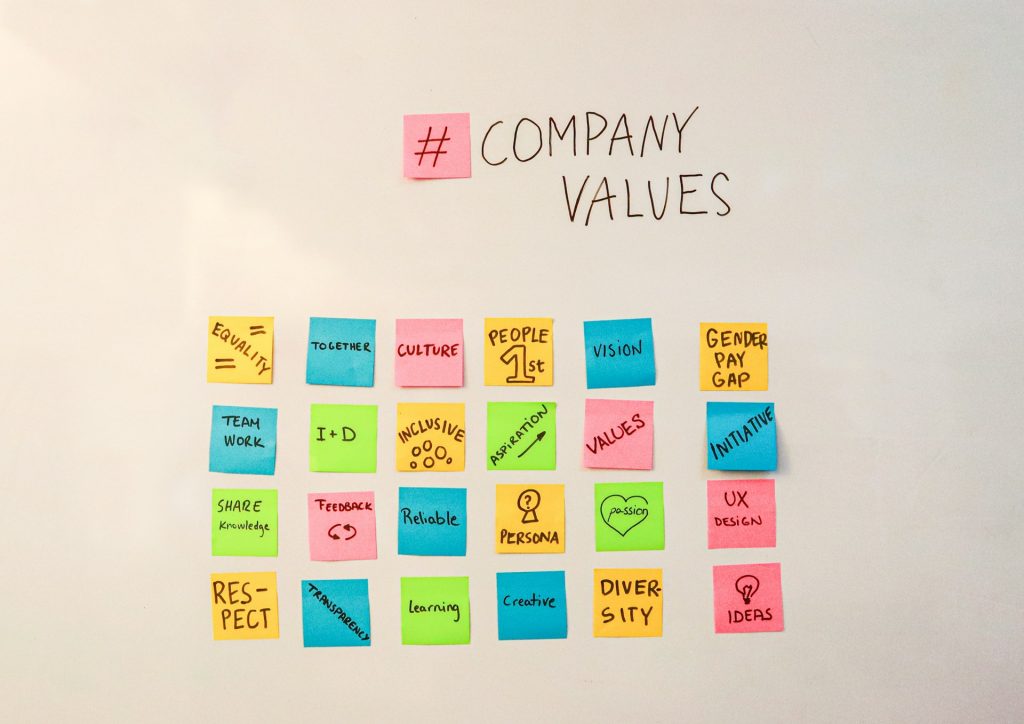
When people talk about business value creation, the conversation often starts with products, customers, sales, and profit. Most business students are introduced to the classic value chain model early in their studies because it explains how companies transform inputs into outputs that customers are willing to pay for. While that model is still useful, modern businesses operate in environments that are far more connected, technology-driven, and knowledge-intensive than before.
Today, value is not created only through manufacturing or selling products. It is also created through collaboration, data, innovation, digital platforms, ecosystems, and knowledge sharing. This shift is why businesses now need to understand three important concepts together: the value chain, the value network, and the value shop.
The Traditional Value Chain
The first model is the value chain, introduced by Michael Porter. This model explains how organizations create value through a sequence of activities that move from suppliers to customers.
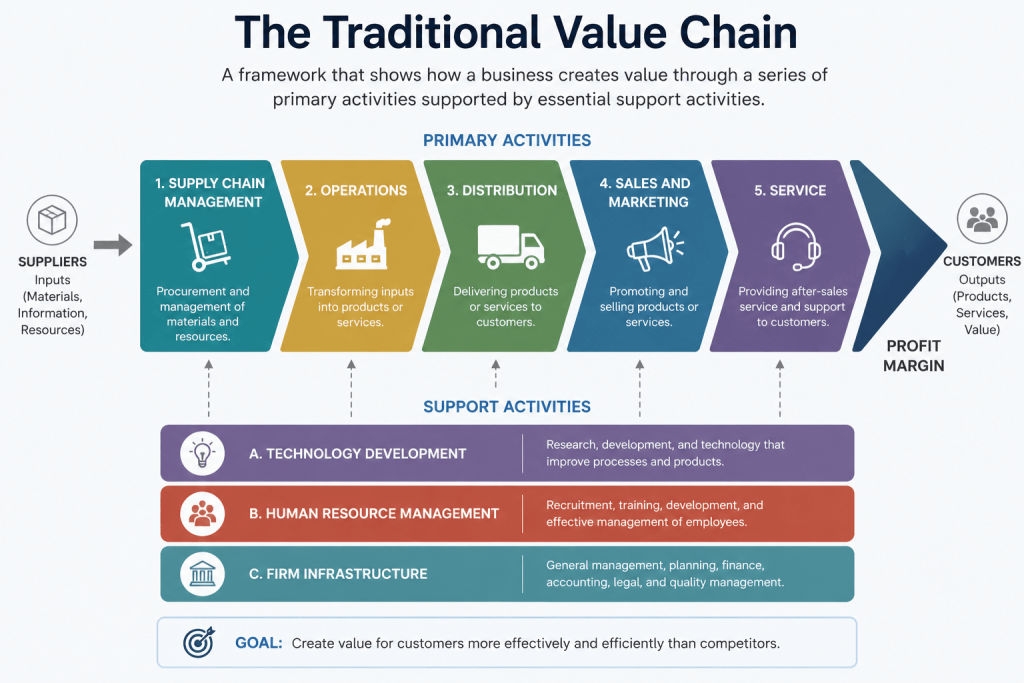
The process usually starts with supply chain management, followed by operations, distribution, sales and marketing, and customer service. Supporting activities such as technology development, human resource management, and administration help these primary activities function effectively.
The idea is simple. Every activity inside the company should contribute to customer value while controlling costs. If a company performs these activities better than its competitors, it gains a competitive advantage and improves profit margins.
This model works very well for manufacturing businesses and product-oriented companies because value is created step by step in a relatively linear flow. A car manufacturer, for example, receives raw materials, assembles vehicles, distributes them to dealers, markets the products, and provides after-sales service. Each stage adds value to the final product.
However, modern businesses no longer operate in such isolated and predictable environments. Digital transformation, platform economies, and global collaboration have changed how organizations create value.
Why the Value Chain Alone Is No Longer Enough
In the past, companies could focus mainly on internal efficiency. Today, businesses depend heavily on external partners, technology providers, investors, regulators, research institutions, and even customers themselves.
A company like Apple does not create value only through internal operations. Its ecosystem includes app developers, suppliers, logistics providers, universities, telecommunications companies, governments, and millions of users who continuously shape the platform.
This is where the concept of the value network becomes important.
The Rise of the Value Network
A value network expands the traditional value chain by recognizing that value is created through relationships and interactions among many different actors.
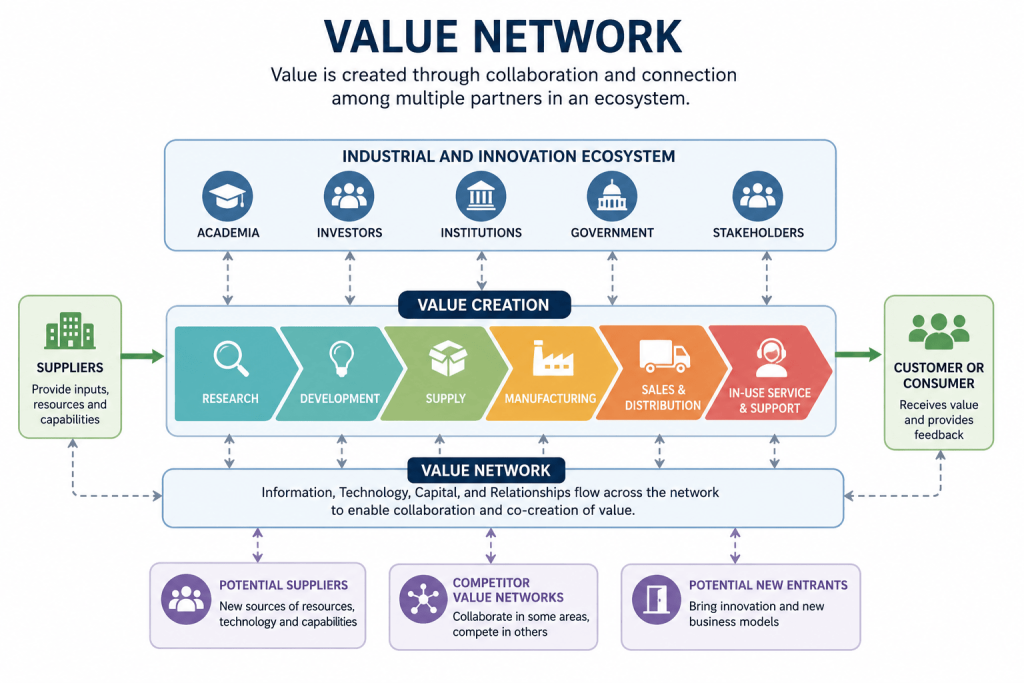
Instead of looking only at internal activities, the value network focuses on the broader ecosystem surrounding the business. This includes academia, investors, institutions, governments, stakeholders, suppliers, competitors, and customers.
In a value network, businesses are connected through information sharing, collaboration, innovation, and technology infrastructure. Value is not simply passed from one stage to another. It is co-created by multiple participants working together.
Technology companies provide strong examples of this model. Companies such as Google, Microsoft, and Amazon rely on massive ecosystems involving cloud infrastructure, software developers, content creators, advertisers, and global users. Their success depends not only on operational efficiency but also on how effectively they manage relationships and enable collaboration across the network.
This shift also changes the role of the customer. Customers are no longer passive buyers. They actively participate in shaping products, sharing feedback, creating online content, influencing brand perception, and contributing data that helps companies improve services.
The value network model reflects the reality of the digital economy, where business success depends on connectivity, partnerships, and innovation ecosystems rather than isolated internal processes.
Understanding the Value Shop
While the value chain focuses on standardized processes and the value network focuses on ecosystems, the value shop addresses a completely different kind of organization.
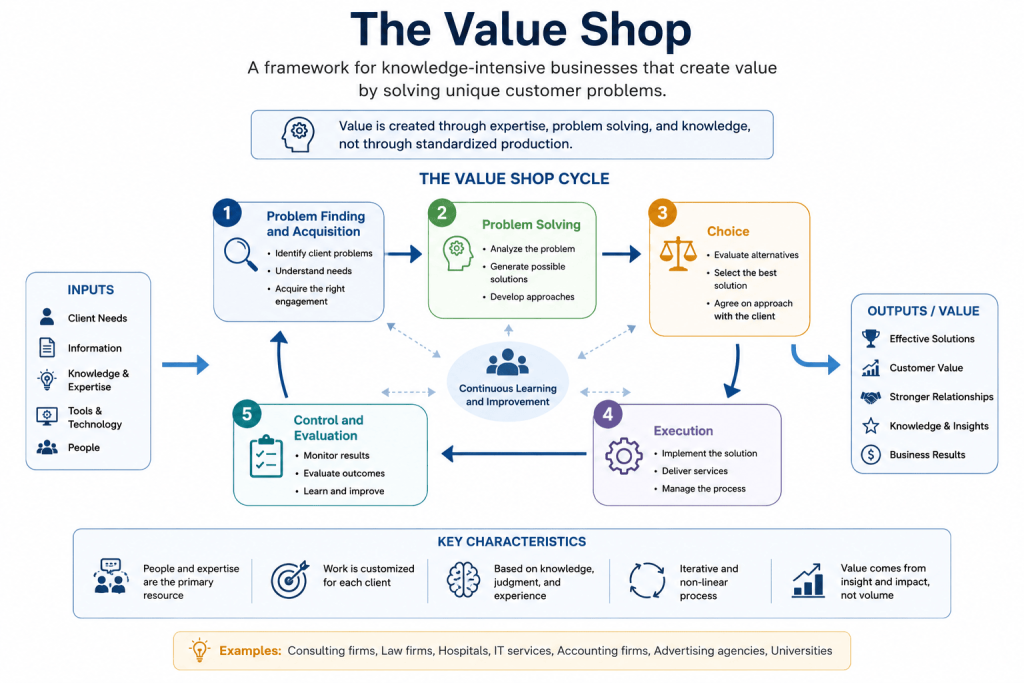
The value shop model is designed for businesses that create value by solving customer problems rather than producing standardized products.
Consulting firms, hospitals, law firms, universities, and IT service companies are good examples. These organizations do not follow a simple linear production process. Instead, they create value through knowledge, expertise, analysis, and decision-making.
The value shop typically involves five activities:
- Problem finding and acquisition
- Problem solving
- Choice
- Execution
- Control and evaluation
This process is cyclical because organizations continuously learn, improve, and adapt while solving unique customer problems.
For example, a consulting company first identifies a client’s issue, analyzes possible solutions, selects the best approach, implements recommendations, and evaluates outcomes. The value comes from expertise and knowledge management rather than physical production.
This model is becoming increasingly important in modern economies where knowledge-based industries continue to grow rapidly.
Technology as the Connecting Force
One thing becomes very clear when comparing these three models: technology now sits at the center of value creation.
In traditional businesses, technology was often treated as a support function. Today, it has become a strategic driver that shapes operations, communication, customer experiences, innovation, and competitive advantage.
Cloud computing, artificial intelligence, data analytics, enterprise systems, and digital platforms allow organizations to coordinate activities across value chains, strengthen value networks, and improve value shop processes.
For example, knowledge management systems help consulting firms store expertise and improve decision-making. Supply chain technologies allow manufacturers to coordinate global operations in real time. Digital platforms enable companies to connect directly with customers and external partners across ecosystems.
Technology is no longer just supporting the business. In many cases, technology is the business itself.
Human Resources and Knowledge Management Matter More Than Ever
Another important insight from these models is the growing importance of human resources and organizational knowledge.
Machines and systems can automate repetitive tasks, but creativity, strategic thinking, innovation, and problem-solving still depend heavily on people. Businesses that manage knowledge effectively often outperform competitors because they learn faster, adapt quicker, and innovate more successfully.
This is especially true in value shop organizations where expertise becomes the main source of value creation. Universities, consulting firms, healthcare providers, and technology companies all rely heavily on skilled professionals and strong knowledge management practices.
In the digital era, talent is not simply a support resource. Talent is a strategic asset.
The Future of Business Value Creation
The future of business value creation will likely combine all three models rather than relying on only one approach.
Manufacturing companies still need efficient value chains. Digital businesses require strong value networks. Knowledge-intensive organizations depend on value shops. Most modern companies now operate using elements of all three at the same time.
Take Tesla as an example. The company uses a value chain for vehicle production, a value network involving suppliers and charging infrastructure partners, and a value shop approach through software development and engineering innovation.
Businesses that understand how these models interact will be better prepared for the challenges of digital transformation, globalization, and rapidly changing customer expectations.
Business value creation is no longer just about producing goods and selling them efficiently. Modern organizations create value through collaboration, technology, ecosystems, expertise, and continuous innovation.
The traditional value chain remains important because operational excellence still matters. However, businesses also need strong value networks to survive in interconnected markets and effective value shop capabilities to solve complex customer problems.
Organizations that successfully integrate these approaches will not only improve profitability but also build stronger relationships, adapt faster to change, and create long-term competitive advantage in an increasingly digital world.