Not every problem has a straightforward solution. While some challenges can be solved using data, mathematical models, or optimization techniques, many organizational problems involve people, differing opinions, organizational culture, and conflicting priorities. In these situations, even agreeing on what the actual problem is can be difficult.
This is where Soft Systems Methodology (SSM) becomes valuable.
Developed by Peter Checkland in the 1970s, SSM is a problem solving methodology designed specifically for complex human activity systems. Rather than assuming that a problem is already well defined, SSM encourages organizations to explore different perspectives, understand stakeholder concerns, and identify improvements that are both desirable and feasible.
Unlike Hard Systems Thinking, which seeks the optimal technical solution, Soft Systems Methodology recognizes that there may be several acceptable solutions depending on the needs and viewpoints of those involved.
In this article, you will learn the Seven Stages of Soft Systems Methodology, understand the purpose of each stage, and discover how the methodology can be applied to real world situations.
Why Soft Systems Methodology Was Developed
Traditional systems engineering methods work well when objectives are clear and measurable. However, Peter Checkland observed that many organizational problems do not fit this description.
Consider the following situations:
- A university wants to improve student engagement.
- A hospital wants to reduce patient waiting times.
- A company struggles with poor collaboration between departments.
- A government agency wants to improve public services.
In each case, different stakeholders may have different opinions about the cause of the problem. Students, lecturers, administrators, managers, customers, and policymakers all bring their own experiences and priorities.
If organizations begin designing solutions without first understanding these perspectives, they risk solving the wrong problem.
Soft Systems Methodology was created to address exactly this type of complexity.
What Is a Human Activity System?
One of the key concepts in Soft Systems Methodology is the Human Activity System (HAS).
Unlike technical systems such as computer networks or manufacturing machines, a Human Activity System consists of people working together to achieve a common purpose. Because people have different goals, beliefs, values, and experiences, these systems are inherently complex.
Examples include:
- A university
- A hospital
- A business organization
- A local government
- A nonprofit organization
The objective of SSM is not to redesign people but to improve how these human activities work together.
Overview of the Seven Stages
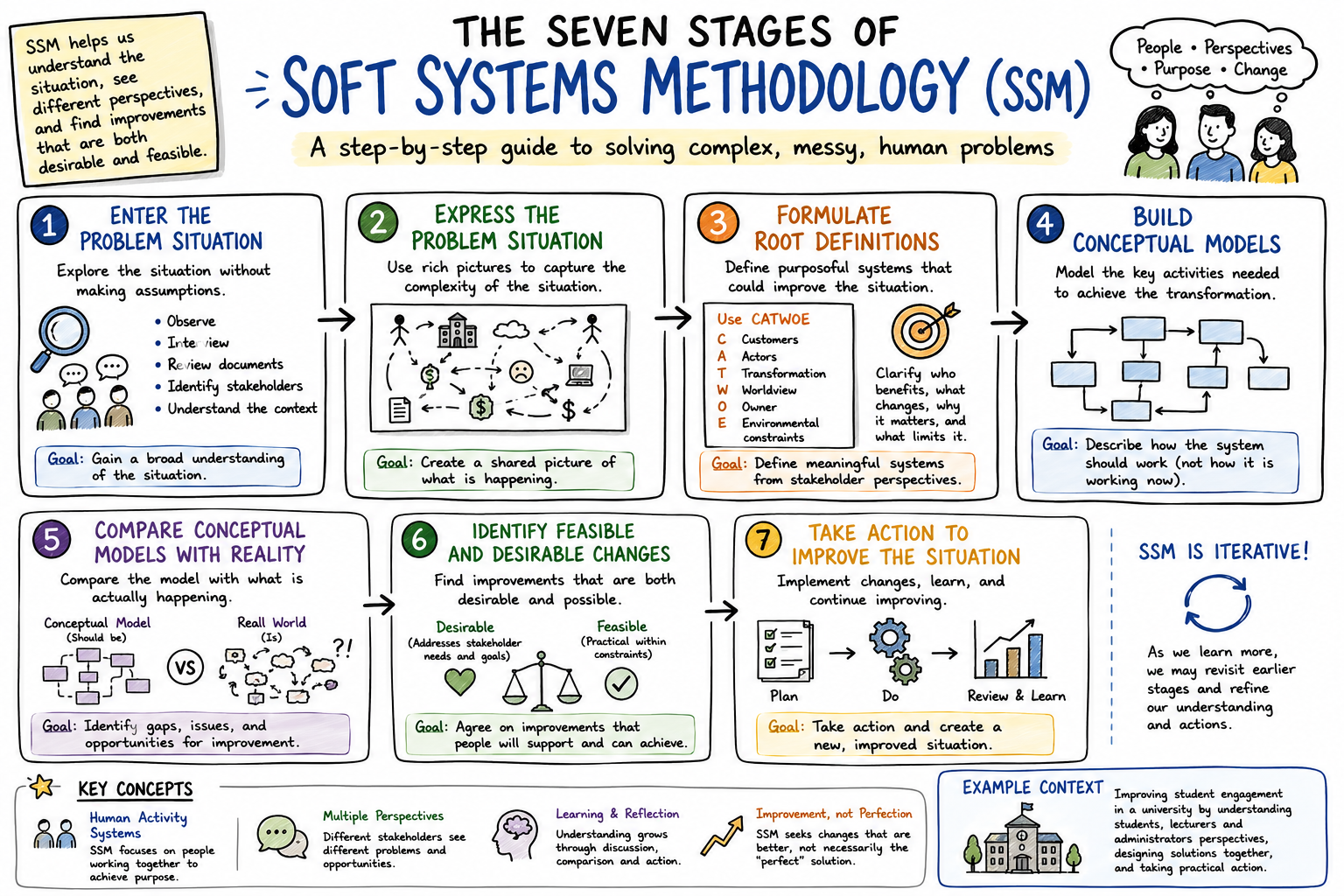
The Seven Stage Model provides a structured process for understanding complex situations before recommending improvements.
The stages are:
- Enter the Problem Situation
- Express the Problem Situation
- Formulate Root Definitions
- Build Conceptual Models
- Compare Conceptual Models with Reality
- Identify Feasible and Desirable Changes
- Take Action
Although these stages are presented sequentially, SSM is not a rigid linear methodology. Organizations often revisit earlier stages as they learn more about the problem.
Stage 1. Enter the Problem Situation
The first stage begins by exploring the situation without assuming what the actual problem is. This is one of the defining characteristics of Soft Systems Methodology. Rather than immediately searching for solutions, analysts invest time in understanding the environment, the stakeholders, and the issues that surround the situation.
Activities during this stage typically include observing organizational processes, interviewing stakeholders, reviewing documents, and identifying the people who are affected by the situation. The goal is not to collect every possible piece of information but to develop a broad understanding of how the organization currently operates.
For example, imagine that a university reports declining student satisfaction. At first glance, it may seem that lecturers need additional training. However, conversations with students, lecturers, and administrators may reveal that the issue also involves outdated learning technologies, slow administrative services, limited academic support, and ineffective communication between departments.
By resisting the temptation to jump directly to solutions, organizations are more likely to identify the real issues rather than their symptoms.
Stage 2. Express the Problem Situation
Once sufficient information has been collected, the next step is to represent the problem situation in a way that reflects its complexity. Rather than producing technical documentation, Soft Systems Methodology often uses a Rich Picture.
A Rich Picture is a free form visual representation that illustrates stakeholders, activities, relationships, communication flows, conflicts, concerns, and environmental influences. Unlike formal diagrams, Rich Pictures encourage creativity and help stakeholders discuss issues more openly.
The purpose of this stage is to create a shared understanding of the current situation. When people can see how different parts of the organization interact, they often recognize issues that were previously overlooked.
For instance, a Rich Picture for a university might show students struggling with outdated learning platforms, lecturers frustrated by administrative procedures, and support staff overwhelmed by manual processes. Seeing these relationships together often provides valuable insights.
Stage 3. Formulate Root Definitions
After expressing the problem situation, analysts identify systems that could improve the situation. These descriptions are called Root Definitions.
A Root Definition describes what a purposeful system should accomplish, who benefits from it, and why it exists. It does not specify technical solutions but instead provides a clear statement of the desired transformation.
To develop effective Root Definitions, analysts typically use the CATWOE framework, which considers:
- Customers: Who benefits or is affected?
- Actors: Who performs the activities?
- Transformation: What change takes place?
- Worldview: Why is the transformation meaningful?
- Owner: Who has the authority to make changes?
- Environmental Constraints: What external factors influence the system?
Using CATWOE ensures that important stakeholder perspectives are considered before designing improvements.
Stage 4. Build Conceptual Models
Once Root Definitions have been established, conceptual models are created to describe the activities required for the proposed system to achieve its objectives.
A conceptual model is not a representation of the existing organization. Instead, it illustrates how the system should operate if it were functioning effectively.
Each activity within the model contributes to the transformation described in the Root Definition. Analysts focus on logical relationships between activities rather than existing organizational structures.
These conceptual models become valuable reference points for evaluating the organization’s current practices.
Stage 5. Compare Conceptual Models with Reality
At this stage, the conceptual models are compared with the actual organization.
The purpose is not to criticize current practices but to identify meaningful differences between the ideal model and reality. This comparison often reveals missing activities, duplicated processes, communication problems, or organizational constraints.
For example, a conceptual model may indicate that students should receive academic feedback within one week. Comparing this expectation with actual practice may reveal that feedback often takes three weeks because lecturers manually process assignments.
The comparison encourages discussion among stakeholders and helps prioritize areas for improvement.
Stage 6. Identify Feasible and Desirable Changes
The insights gained during the comparison stage are then used to identify improvements.
An improvement must satisfy two important criteria.
First, it should be desirable, meaning it addresses stakeholder concerns and contributes to organizational goals.
Second, it should be feasible, meaning it can realistically be implemented within the organization’s financial, technical, legal, and cultural constraints.
Some ideal solutions may be impossible because of limited budgets or organizational resistance. Therefore, SSM emphasizes practical improvements that stakeholders are willing to support.
Stage 7. Take Action to Improve the Situation
The final stage involves implementing the agreed improvements and evaluating their impact.
Unlike many traditional methodologies, Soft Systems Methodology views implementation as the beginning of a new learning cycle rather than the end of a project.
Organizations should monitor outcomes, gather stakeholder feedback, and continue refining their processes as circumstances change. New challenges may emerge, requiring stakeholders to revisit earlier stages of the methodology.
This iterative approach enables organizations to adapt continuously while improving both organizational performance and stakeholder satisfaction.
A Practical Example: Improving Student Engagement
Imagine a university that wants to improve student engagement.
The SSM process might look like this:
| Stage | Example |
|---|---|
| 1. Enter the Situation | Interview students, lecturers, and administrators to understand current challenges. |
| 2. Express the Situation | Create a Rich Picture showing communication gaps, outdated systems, and student concerns. |
| 3. Root Definitions | Define a system that improves engagement through better communication and learning support. |
| 4. Conceptual Model | Design activities such as regular feedback, online mentoring, and early intervention for at risk students. |
| 5. Compare | Compare the conceptual model with current university practices. |
| 6. Improvements | Prioritize changes such as upgrading the learning management system and enhancing academic advising. |
| 7. Action | Implement the improvements and evaluate student engagement over time. |
This example demonstrates how SSM guides organizations from uncertainty to informed action without assuming that the initial understanding of the problem is correct.
Common Mistakes When Applying SSM
Although SSM is flexible, organizations often encounter challenges when applying it.
One common mistake is rushing through the early stages and attempting to define the problem before understanding the situation. Another is excluding important stakeholders from the discussion, which can lead to incomplete or biased analyses.
Some organizations also focus too heavily on technical solutions while ignoring organizational culture and communication. Finally, treating SSM as a rigid checklist rather than an iterative learning process limits its effectiveness.
Successful application of SSM requires patience, open communication, and a willingness to revisit earlier assumptions as new insights emerge.
Looking Ahead
One of the most widely used tools within Soft Systems Methodology is the CATWOE framework, which helps analysts develop strong Root Definitions by considering stakeholders, transformations, and environmental constraints.
In the next article, we will explore CATWOE Analysis in detail, learning how each element contributes to understanding complex organizational problems and how the framework can be applied through practical examples.
Conclusion
Soft Systems Methodology provides a structured yet flexible approach for addressing complex organizational challenges where people, perspectives, and culture play a central role. Rather than rushing toward technical solutions, it encourages organizations to first understand the problem situation, engage stakeholders, and explore multiple viewpoints before identifying practical improvements.
The Seven Stage Model offers a roadmap for navigating uncertainty while promoting collaboration, learning, and continuous improvement. Whether applied in education, healthcare, business, or government, SSM helps organizations move beyond assumptions and develop solutions that are both effective and widely supported.
As organizations continue to face increasingly complex challenges, the ability to understand systems from multiple perspectives will become an essential skill for managers, analysts, educators, and decision