

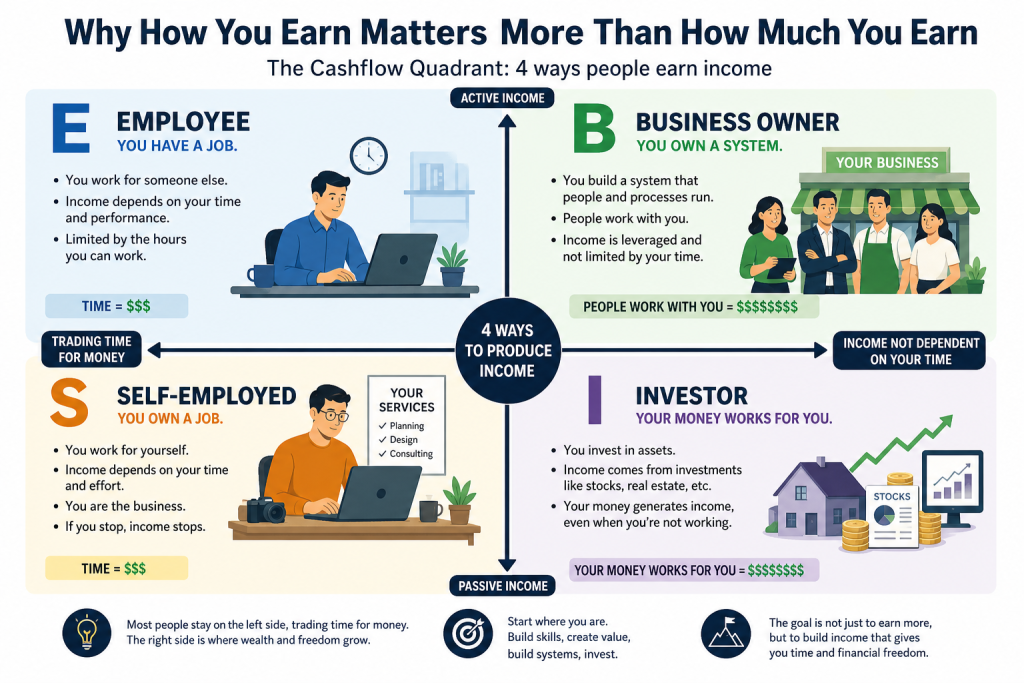
If you have ever felt like working harder does not always lead to getting ahead, then you are already close to understanding the idea behind the cashflow quadrant. The image breaks income into four simple categories, and once you see the pattern, it becomes clear why some people stay stuck while others gradually build wealth.
Let’s unpack it in a way that connects to everyday life.
The Four Ways People Earn Money
The quadrant is divided into four parts: Employee, Self-Employed, Business Owner, and Investor. Each one reflects a different way of earning income, and more importantly, a different relationship with time, effort, and control.
1. Employee (E): You Have a Job
This is where most people start and often stay. You work for an organization, you receive a salary, and your income depends on your time and performance. There is a clear structure here. You know what to do, when to do it, and how much you will be paid. That predictability can be comforting. At the same time, your earning potential is limited because there are only so many hours you can work. Think about a lecturer teaching scheduled classes. The effort is consistent, the income is stable, but growth is usually incremental rather than exponential.
2. Self-Employed (S): You Own a Job
This path often feels like freedom at first. You work for yourself, you set your own schedule, and you have more control over your income. However, the core pattern has not changed as much as it seems. You are still trading time for money, except now everything depends on you. A freelance consultant is a good example. You can earn more than a salaried employee, but if you stop working, the income slows down or disappears. You are not just doing the work, you are also finding clients, managing operations, and handling risk. This is why the idea of “owning a job” fits so well here. You are independent, but you are also fully responsible.
3. Business Owner (B): You Own a System
This is where the shift becomes more visible. A business owner builds something that can operate beyond their personal effort. Instead of doing everything alone, they create systems, hire people, and design processes that allow the business to run with less direct involvement. Imagine running a small café. At the beginning, you might handle everything yourself. Over time, you train staff, set up procedures, and delegate responsibilities. Eventually, the café continues to generate income even when you are not physically present. The key idea is leverage. Other people and systems contribute to the output, so your income is no longer limited by your own time.
4. Investor (I): Your Money Works for You
On the far right of the quadrant, the mindset shifts again. Instead of focusing on work or systems, you focus on assets. You put your money into investments that generate returns over time. This could mean buying stocks, investing in property, or funding businesses. The goal is to create income that does not depend on your daily effort. For example, rental income from property or dividends from stocks can continue to flow even when you are not actively working. That does not mean it requires no effort at all, but it does mean your time is no longer the main driver of income.
Why the Right Side Feels Different
The left side of the quadrant, which includes Employees and Self-Employed individuals, is where most people operate. It is familiar and often feels safer, but it also creates limits because income is tied directly to effort. The right side, which includes Business Owners and Investors, opens up more possibilities. Income can grow through systems and assets rather than just personal work. That difference is what makes the right side appealing, but it also requires a different way of thinking.
The Shift Is About Mindset, Not Just Money
Moving from left to right is not simply about earning more. It is about changing how you think about income. An employee focuses on earning from time and skills. A self-employed person focuses on independence and control. A business owner focuses on building systems. An investor focuses on growing assets. Each step involves new risks, new skills, and new ways of making decisions.
A Practical Way to Move Forward
You do not need to jump from one side to the other overnight. In reality, most people move gradually. You might start with a stable job, then explore side work, then build something scalable, and eventually invest what you earn. For example, someone could begin as a lecturer, take on consulting projects, build a small training business, and later invest the profits into property or financial markets. Each step reduces dependence on personal time and increases the role of systems or assets. The cashflow quadrant is simple, but it changes how you look at work and income. It reminds you that earning more is only one part of the story. The bigger question is how that income is created. Once you understand that, you can make more deliberate choices about where you want to be and how you plan to get there.