

Businesses today generate more data than ever before.
Every online purchase, social media interaction, GPS location, website visit, and mobile app activity creates digital information. Companies collect data from customers, employees, machines, sensors, and entire supply chains every second.
This explosion of information is what we call Big Data.
But while big data creates huge opportunities, it also creates major operational challenges.
Many organizations assume that having more data automatically leads to better decisions. In reality, managing massive amounts of fast moving and complex data is far more difficult than most companies expect.
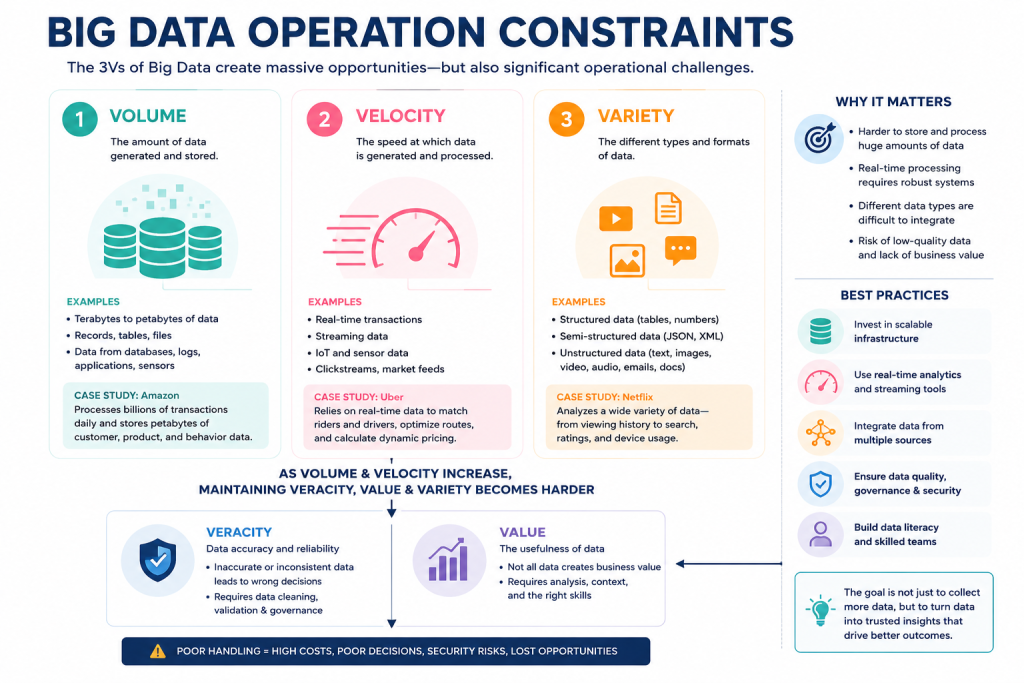
One of the most common frameworks used to explain big data challenges is known as the 3Vs of Big Data:
- Volume
- Velocity
- Variety
As data grows in these dimensions, businesses often face operational constraints related to accuracy, value, and reliability.
The image above illustrates an important reality:
when volume and velocity increase rapidly, maintaining veracity, value, and variety becomes more difficult.
In simple terms, more data can actually create more problems if companies are not prepared to manage it properly.
The First V: Volume
Volume refers to the amount of data generated and stored.
Today, organizations collect enormous quantities of information from:
- Online transactions
- Mobile applications
- Websites
- Social media platforms
- Smart devices
- Customer databases
- Sensors and IoT systems
Years ago, companies measured data in megabytes or gigabytes.
Now, businesses often deal with terabytes, petabytes, or even exabytes of data.
Case Study: Amazon
Amazon processes massive amounts of customer data every day.
The company tracks:
- Purchase history
- Search behavior
- Product clicks
- Delivery information
- Customer reviews
- Streaming activity
- Voice assistant interactions
This huge volume of data helps Amazon improve:
- Product recommendations
- Inventory management
- Delivery efficiency
- Customer personalization
However, storing and processing such massive datasets requires enormous infrastructure investments.
Amazon operates large scale cloud computing systems through Amazon Web Services to support these operations.
The Operational Constraint
As data volume increases, businesses face several challenges:
- Higher storage costs
- Slower processing times
- Increased cybersecurity risks
- Difficulties organizing information
- Greater complexity in data management
Many companies collect huge amounts of data but struggle to transform it into useful insights.
More data is not always better if businesses cannot use it effectively.
The Second V: Velocity
Velocity refers to the speed at which data is generated, processed, and analyzed.
In the digital era, data moves extremely fast.
Businesses no longer wait weeks or months for reports. Many companies now rely on real-time analytics to make immediate decisions.
Examples of high velocity data include:
- Social media activity
- Financial transactions
- GPS tracking
- Online shopping behavior
- Ride hailing applications
- Live streaming platforms
Case Study: Uber
Uber depends heavily on real-time data velocity.
The platform constantly processes:
- Driver locations
- Passenger requests
- Traffic conditions
- Pricing calculations
- Estimated arrival times
Every second matters.
When a customer books a ride, Uber’s system must instantly analyze available drivers, traffic patterns, and distance calculations.
Without fast data processing, the entire service experience would fail.
The Operational Constraint
High velocity creates pressure on businesses to process information quickly and accurately.
Companies may face:
- System overload
- Delayed responses
- Data bottlenecks
- Server failures
- Poor customer experiences
For example, during major online shopping events like Black Friday, e-commerce platforms often experience traffic spikes.
If systems cannot process data quickly enough, websites may crash, payments may fail, and customers may leave.
This demonstrates why velocity is both an opportunity and a challenge.
The Third V: Variety
Variety refers to the different types and formats of data.
Traditional business systems mainly handled structured data such as spreadsheets and databases.
Today, companies manage both structured and unstructured data, including:
- Videos
- Images
- Emails
- Audio files
- Social media posts
- Sensor readings
- Chat messages
This creates much greater complexity.
Case Study: Netflix
Netflix collects a wide variety of user data.
The company analyzes:
- Viewing history
- Search activity
- Device usage
- Watch duration
- Ratings
- User preferences
- Viewing pauses and rewinds
Netflix combines these different data types to improve:
- Content recommendations
- User experience
- Content production decisions
- Personalized marketing
The company’s recommendation engine is one reason Netflix keeps users engaged for long periods.
The Operational Constraint
Managing multiple data formats is difficult because different systems may not communicate effectively.
Businesses often struggle with:
- Data integration problems
- Inconsistent formats
- Poor data quality
- Duplicate information
- Difficulty analyzing unstructured content
For example, analyzing customer comments on social media is far more complex than analyzing numbers in spreadsheets.
Human language contains emotions, sarcasm, slang, and cultural differences that machines may misunderstand.
Beyond the 3Vs: Veracity and Value
As big data evolved, experts introduced additional concepts such as:
- Veracity
- Value
These are critical because large amounts of data are meaningless if the information is inaccurate or useless.
Veracity: Can the Data Be Trusted?
Veracity refers to data accuracy and reliability.
Poor quality data can lead to:
- Wrong business decisions
- Misleading analytics
- Financial losses
- Reputation damage
Case Study: Healthcare Data Problems
Hospitals and healthcare organizations manage enormous amounts of patient information.
If medical records contain inaccurate data, the consequences can be serious.
Incorrect patient information may lead to:
- Wrong diagnoses
- Medication errors
- Insurance problems
- Delayed treatments
This is why data accuracy is extremely important in industries like healthcare, banking, and aviation.
Value: Does the Data Actually Help?
Collecting data alone is not enough.
Businesses must generate meaningful insights that improve:
- Decision making
- Customer experience
- Efficiency
- Innovation
- Profitability
Many organizations collect huge datasets but fail to extract real business value from them.
This creates what experts sometimes call “data rich but insight poor” companies.
Why Big Data Creates Operational Constraints
The graph shown in the image highlights an important relationship.
As volume and velocity increase, maintaining:
- Veracity
- Value
- Variety
becomes increasingly difficult.
This creates operational constraints because businesses must balance:
- Speed
- Accuracy
- Storage
- Security
- Scalability
- Cost
The challenge is not simply collecting data.
The real challenge is managing it effectively.
Real World Example: Social Media Platforms
Companies like Meta Platforms handle enormous amounts of user generated data every second.
This includes:
- Photos
- Videos
- Comments
- Messages
- Live streams
- Advertisements
The company must process data quickly while also:
- Detecting harmful content
- Preventing misinformation
- Protecting user privacy
- Delivering personalized recommendations
As data volume and velocity grow, these responsibilities become much harder.
This demonstrates how operational constraints increase alongside data complexity.
Why Businesses Need Better Data Strategies
Many companies focus heavily on collecting data but invest too little in:
- Data governance
- Data security
- Data quality management
- Analytics capabilities
- Skilled data professionals
Without proper strategy, organizations may become overwhelmed by their own information systems.
Successful companies treat data as a strategic asset, not simply as digital storage.
They focus on:
- Collecting relevant data
- Improving data quality
- Building scalable systems
- Generating actionable insights
Big data has transformed modern business.
Organizations now have access to more information than ever before, creating opportunities for personalization, automation, innovation, and smarter decision making.
However, big data also creates serious operational constraints.
As data becomes larger, faster, and more complex, businesses face growing challenges related to:
- Accuracy
- Reliability
- Processing speed
- Integration
- Security
- Business value
The companies that succeed in the digital era are not necessarily the ones with the most data.
They are the ones that know how to manage, analyze, and use data effectively.