

In business, competition is unavoidable.
Every company wants customers, growth, and long term success. But businesses do not all compete in the same way. Some companies win by offering the lowest prices. Others succeed because they provide something unique, premium, or highly specialized.
This is the main idea behind Porter’s Generic Strategies, a framework introduced by Michael Porter. The framework explains how companies create competitive advantage and survive in crowded markets.
Even today, Porter’s model remains one of the most widely used business strategy frameworks in universities, corporations, and startups.
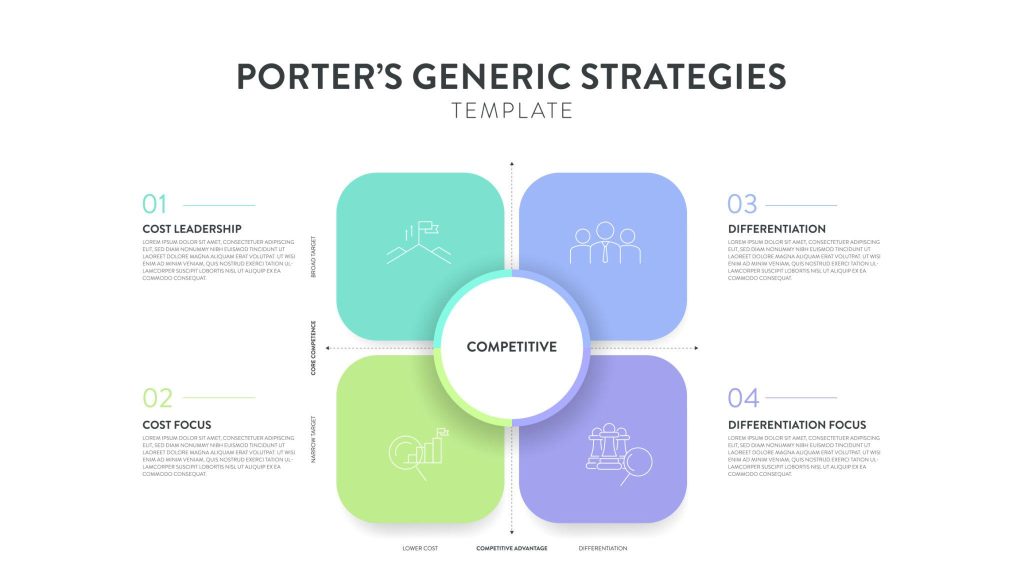
The framework is built around two important ideas.
First, businesses must decide how they want to compete. They can either compete through lower cost or through differentiation.
Second, businesses must decide who they want to target. Some companies target the broad market, while others focus on a smaller niche.
When these ideas are combined, four major strategies appear:
- Cost Leadership
- Differentiation
- Focus Strategy
- Differentiation Focus Strategy
The important lesson is simple. Businesses need a clear identity. Companies that try to be everything for everyone often struggle because customers no longer understand what makes them special.
Cost Leadership Strategy
A company using a cost leadership strategy tries to become the lowest cost producer in its industry.
The goal is not simply selling cheap products. The real objective is operating more efficiently than competitors. When costs are lower, companies can offer competitive prices while still maintaining profit.
Businesses usually achieve this through:
- Large scale production
- Efficient operations
- Automation
- Strong supply chain management
- Standardized products and services
One of the most famous examples is Walmart.
Walmart built its business around affordable pricing. The company purchases products in massive quantities, giving it strong bargaining power with suppliers. It also invests heavily in logistics, warehouse systems, and operational efficiency.
Because Walmart controls costs effectively, it can offer lower prices than many competitors.
This strategy becomes especially powerful during economic downturns. When consumers become more careful with spending, lower prices become more attractive.
Another strong example is AirAsia.
AirAsia transformed air travel in Southeast Asia by making flying more affordable for ordinary people.
The airline reduced costs by:
- Using a single aircraft type
- Minimizing free onboard services
- Encouraging online bookings
- Maximizing aircraft usage each day
Instead of offering luxury experiences, AirAsia focused on efficiency and affordability.
The strategy worked extremely well because many customers prioritized low ticket prices over premium services.
However, cost leadership also comes with risks. Profit margins can become very thin, competitors may start price wars, and customers may associate low prices with lower quality.
This means companies must constantly improve efficiency to stay ahead.
Differentiation Strategy
While cost leadership focuses on affordability, differentiation focuses on uniqueness.
Companies using this strategy try to offer products or services that customers see as different and more valuable than competitors.
This differentiation may come from:
- Product quality
- Innovation
- Design
- Customer experience
- Branding
- Technology
One of the strongest examples is Apple.
Apple does not compete by offering the cheapest smartphones or laptops. Instead, the company focuses on premium design, ecosystem integration, simplicity, and strong brand identity.
Customers often pay significantly higher prices for Apple products because they value the experience and image associated with the brand.
Apple’s success shows an important principle of differentiation:
people are often willing to pay more for products they emotionally connect with.
Another well known example is Starbucks.
Starbucks does not simply sell coffee. It sells atmosphere, comfort, lifestyle, and personalization.
Many customers can find cheaper coffee elsewhere, yet Starbucks continues to attract loyal customers because the brand experience feels different.
The stores are designed to feel welcoming, the customer experience is consistent, and the brand has become associated with modern lifestyle culture.
Differentiation can create strong customer loyalty and higher profit margins. However, it also requires continuous innovation. Competitors may imitate successful features, and customer expectations can change quickly.
A differentiated company cannot afford to stand still.
Focus Strategy
A focus strategy targets a specific niche market rather than the broader market.
Instead of trying to serve everyone, companies concentrate on a smaller customer group with specialized needs.
This strategy works well when businesses deeply understand a particular audience better than competitors.
A strong example is Rolls-Royce Motor Cars.
Rolls Royce does not aim to sell millions of vehicles globally like mass market car manufacturers. Instead, the company focuses on ultra luxury customers who value exclusivity, craftsmanship, and prestige.
The company’s vehicles are expensive, customized, and highly exclusive. That exclusivity itself becomes part of the product’s value.
Another interesting case is GoPro.
GoPro focused specifically on action camera users such as athletes, adventurers, travelers, and content creators.
Rather than competing directly against traditional camera brands, GoPro built products designed for extreme activities and active lifestyles.
The company also built a strong community around adventure and user generated content, helping strengthen its niche positioning.
Focus strategies can create loyal customers because businesses understand their audience deeply. However, niche markets are usually smaller, and trends can change rapidly.
If customer preferences shift, focused businesses may face serious challenges.
Differentiation Focus Strategy
A differentiation focus strategy combines niche targeting with uniqueness.
These companies target a specialized market while also offering premium or highly differentiated products.
One of the best examples is Tesla during its early growth phase.
When Tesla first entered the automotive industry, it did not target the mass market. Instead, the company focused on customers interested in premium electric vehicles with advanced technology and sustainability features.
Tesla differentiated itself through:
- High performance electric cars
- Futuristic design
- Battery innovation
- Autopilot technology
- Direct to consumer sales
Before Tesla, electric vehicles were often seen as slow, unattractive, and impractical. Tesla changed that perception completely.
The company made electric cars feel exciting, premium, and innovative.
Another excellent example is Rolex.
Rolex targets a niche luxury market, but the brand also differentiates itself through prestige, craftsmanship, heritage, and status symbolism.
People do not only buy Rolex watches to tell time. Many customers buy them because the brand represents success and exclusivity.
This combination of niche targeting and strong differentiation allows premium brands to maintain high profit margins.
However, differentiation focus strategies also face risks. The target market is limited, customer expectations are extremely high, and economic downturns can reduce demand for premium products.
When Companies Become “Stuck in the Middle”
One of Porter’s most important warnings is about companies becoming “stuck in the middle.”
This happens when businesses fail to develop a clear competitive strategy.
A company may:
- Fail to become low cost
- Fail to differentiate
- Fail to dominate a niche
As a result, customers become confused about what the brand actually stands for.
A commonly discussed example is Nokia during the smartphone revolution.
Nokia once dominated the global mobile phone market. However, as smartphones evolved rapidly, competitors such as Apple and Samsung moved faster in areas like software ecosystems, design, and user experience.
Nokia struggled to maintain a strong competitive identity during this transition period.
The company was no longer clearly leading on cost, differentiation, or innovation.
This demonstrates why strategic clarity matters so much in business.
Why Porter’s Strategies Still Matter Today
Although Porter introduced this framework decades ago, it remains highly relevant in the digital era.
Modern companies still need to answer important questions:
- Why should customers choose us?
- What makes us different?
- Are we competing on price or value?
- Are we targeting mass markets or niche audiences?
Even technology companies follow Porter’s strategies.
Amazon uses operational efficiency and scale to support cost leadership.
Netflix differentiates through content, recommendation systems, and user experience.
Spotify differentiates through personalization and music discovery features.
Technology changes quickly, but competitive strategy remains essential.
Porter’s Generic Strategies continue to provide valuable lessons for businesses of all sizes.
The framework reminds companies that success is not only about having good products. Businesses also need a clear strategy that explains:
- who they serve,
- how they create value,
- and why customers should choose them over competitors.
Some companies win through lower costs.
Others succeed through innovation, premium experiences, or niche specialization.
But the most successful businesses usually have one thing in common:
they understand exactly how they want to compete.