

Not every collaborative learning activity needs lively discussion. In fact, some of the most thoughtful learning happens in silence.
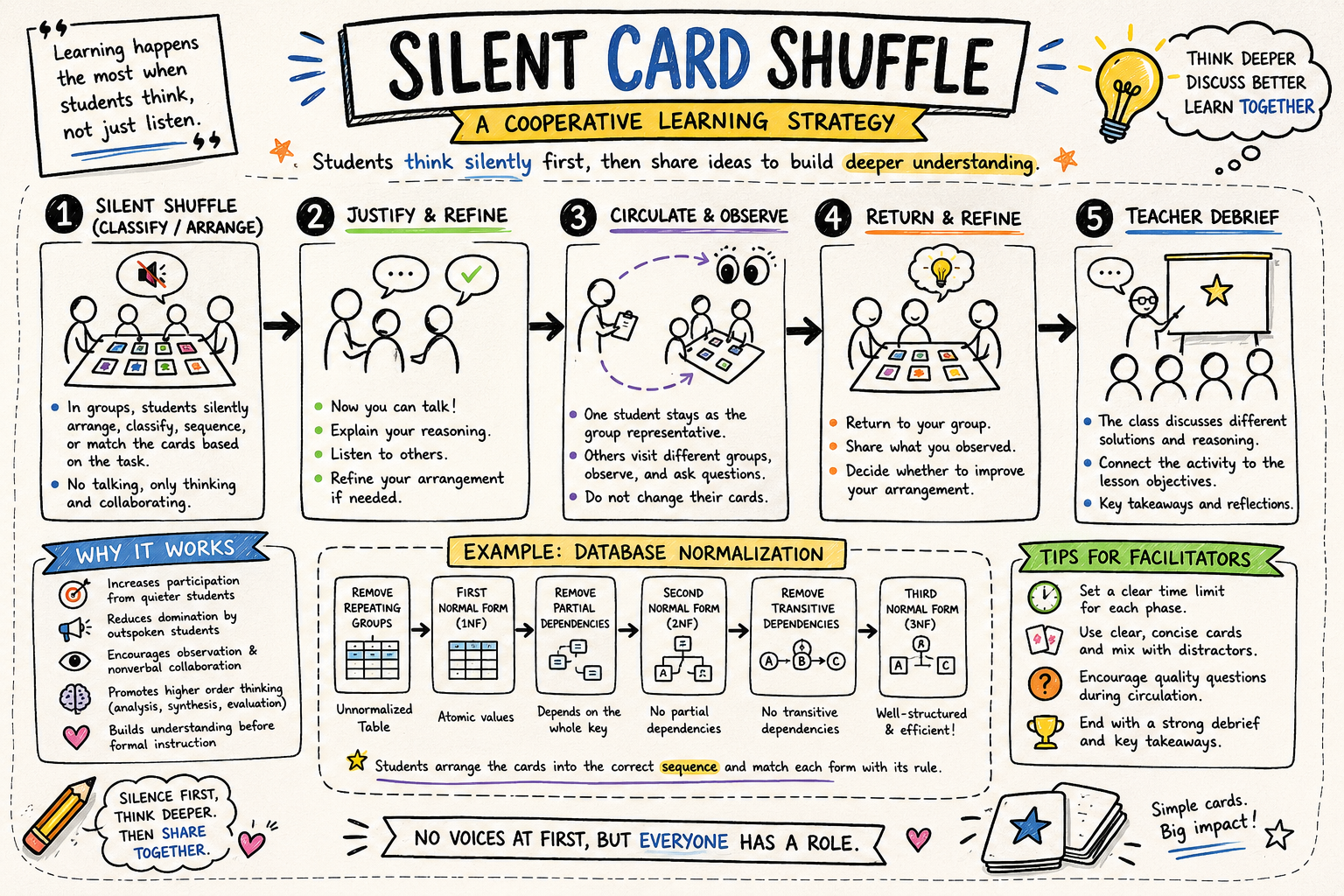
Silent Card Shuffle is an active learning strategy that challenges students to organize, classify, and connect ideas without speaking. Instead of relying on verbal discussion, students communicate through observation, reasoning, and collaboration, making it an excellent technique for promoting critical thinking and ensuring that every student participates.
Despite its simplicity, Silent Card Shuffle can be used across almost any discipline, from Computer Science and Digital Business to Engineering, Business, and the Social Sciences.
What Is Silent Card Shuffle?
Silent Card Shuffle is a collaborative activity where students work together to arrange a set of cards into a logical order or meaningful categories without talking.
Each card contains a piece of information, such as:
- A concept
- A definition
- A process step
- A keyword
- A diagram
- A code snippet
- A business scenario
- A problem statement
Students communicate only through gestures, movement, and careful observation as they negotiate where each card belongs.
Once the activity is complete, the class discusses the final arrangement and reflects on the reasoning behind it.
Why Use Silent Card Shuffle?
Silent Card Shuffle is more than a sorting exercise. It encourages students to actively construct knowledge together.
The activity supports several important learning principles.
Active Learning
Students interact directly with course content rather than passively listening to explanations.
Critical Thinking
Learners must analyze relationships, identify patterns, compare ideas, and justify decisions.
Equal Participation
Because speaking is not allowed, dominant personalities are less likely to control the activity. Every student contributes by moving, arranging, or reconsidering the cards.
Collaborative Problem Solving
Students learn to interpret the intentions of others and build shared understanding through nonverbal collaboration.
Reflection
The discussion after the activity often becomes richer because students are eager to explain the decisions they made during the silent phase.
How Does Silent Card Shuffle Work?
Step 1: Prepare the Cards
The lecturer prepares a set of cards based on the lesson.
Examples include:
- Programming concepts and their definitions
- Business models and real world examples
- Cybersecurity threats and corresponding mitigation strategies
- Database terms and descriptions
- UX principles and practical applications
Depending on the learning objective, there may be between 10 and 30 cards.
Step 2: Form Small Groups
Students work in groups of four to six.
Each group receives the same set of shuffled cards.
Step 3: Explain the Rules
Students must complete the activity without speaking.
They may:
- Move cards.
- Rearrange existing cards.
- Point to relationships.
- Use facial expressions or gestures.
They may not:
- Talk.
- Write explanations.
- Use mobile phones or online resources.
Step 4: Arrange the Cards
The group works together to organize the cards according to the task.
Possible objectives include:
- Matching concepts with definitions
- Sequencing a process
- Categorizing items
- Building a workflow
- Identifying cause and effect
- Grouping similar concepts
Step 5: Discussion
After time is up, students may finally speak.
Each group explains:
- Why they arranged the cards that way.
- Which cards created disagreement.
- What they learned during the activity.
The lecturer then clarifies misconceptions and highlights key concepts.
Example in a Digital Business Class
Imagine students are learning about digital transformation.
The cards include:
- Cloud Computing
- Artificial Intelligence
- Internet of Things
- Big Data
- Blockchain
- Automation
- Customer Experience
- Digital Strategy
The task is to organize the cards into three categories:
- Technologies
- Business Capabilities
- Business Outcomes
Without speaking, students negotiate where each card belongs. Some cards may fit more than one category, creating productive ambiguity that becomes the focus of the class discussion.
Variations
Silent Card Shuffle is highly adaptable.
Sequence Challenge
Arrange the stages of a software development lifecycle or business process in the correct order.
Matching Game
Match terminology with definitions, images, formulas, or code fragments.
Classification
Group cards into categories such as strengths, weaknesses, opportunities, and threats in a SWOT analysis.
Cause and Effect
Arrange cards to illustrate how one event influences another.
Prioritization
Rank solutions based on importance, impact, feasibility, or risk.
Online Implementation
The activity also works well in online or hybrid classrooms.
Students can use collaborative whiteboard tools such as:
- Miro
- Microsoft Whiteboard
- FigJam
- Mural
- Google Jamboard alternatives
- Canva Whiteboards
During the silent phase, students communicate only by moving digital cards and cursors, without using voice or chat. Discussion begins only after the arrangement is complete.
Benefits
Silent Card Shuffle offers many advantages.
- Encourages active participation from every student.
- Develops analytical and organizational thinking.
- Reduces dominance by outspoken students.
- Promotes collaboration through observation rather than conversation.
- Reveals misconceptions that may remain hidden during lectures.
- Requires minimal classroom resources.
- Can be completed in 15 to 30 minutes.
Challenges
Students may initially find the silence uncomfortable, especially if they are accustomed to discussing every decision.
The activity may also become chaotic if the task is too broad or the cards are poorly designed. Clear instructions and carefully selected content are essential.
Finally, the reflection stage should never be skipped. Much of the learning occurs when students explain the reasoning behind their decisions and compare alternative approaches.
Tips for Success
To get the most from Silent Card Shuffle:
- Begin with a manageable number of cards.
- Design tasks that require reasoning rather than simple memorization.
- Avoid questions with only one obvious answer whenever possible.
- Observe group interactions without intervening immediately.
- Use the final discussion to address misconceptions and reinforce key concepts.
- Align the activity with the intended learning outcomes and assessment.
Final Thoughts
Silent Card Shuffle demonstrates that collaboration does not always require conversation. By temporarily removing speech, students become more attentive to the structure of ideas, the actions of their peers, and the reasoning behind their decisions.
The activity creates an inclusive learning environment where every participant contributes, regardless of confidence or communication style. More importantly, it encourages students to analyze, organize, and reflect rather than simply memorize information.
Whether you teach Computer Science, Digital Business, Engineering, Business, or another discipline, Silent Card Shuffle is a practical strategy that transforms classroom content into an engaging, collaborative learning experience. Sometimes, the quietest moments in the classroom lead to the deepest learning.