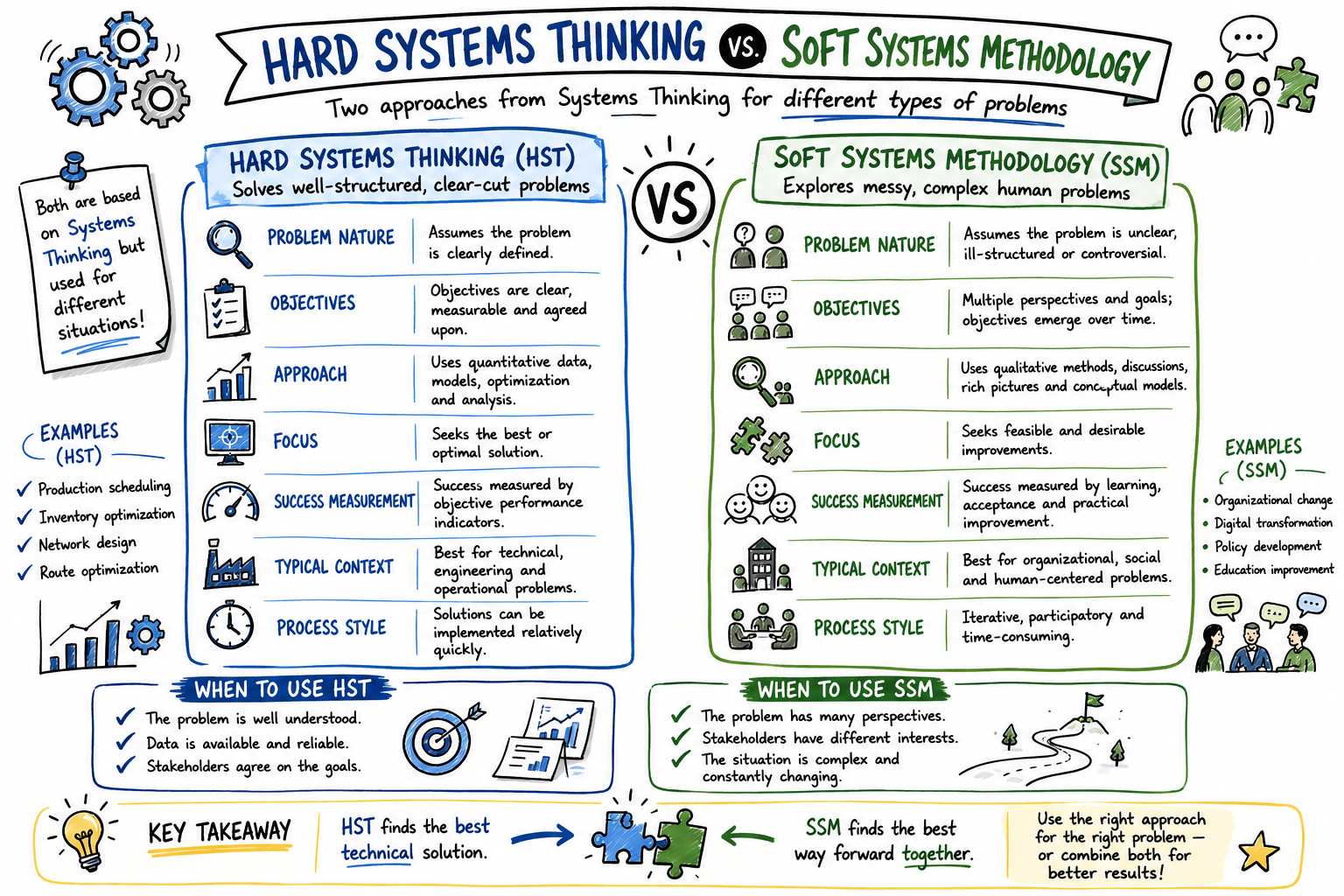
In the previous article, we introduced Systems Thinking as a holistic approach to understanding how different parts of a system interact with one another. Rather than focusing on isolated events, Systems Thinking encourages us to examine relationships, patterns, and feedback loops to identify the root causes of problems.
However, not all problems are the same. Some are straightforward, with clear objectives and measurable outcomes. Others are messy, involving multiple stakeholders, conflicting opinions, and uncertain goals. Because of these differences, a single problem solving approach is not suitable for every situation.
To address this challenge, Systems Thinking has evolved into different methodologies, two of the most widely recognized being Hard Systems Thinking (HST) and Soft Systems Methodology (SSM). Although both are based on Systems Thinking, they differ significantly in their assumptions, objectives, and methods.
This article explores the characteristics of Hard Systems Thinking and Soft Systems Methodology, compares their strengths and limitations, and explains when each approach should be applied.
Why Different Approaches Are Needed
Organizations rarely encounter only one type of problem. Some challenges are highly technical and can be solved through analysis and optimization, while others involve people, organizational culture, and conflicting interests.
Imagine a manufacturing company experiencing frequent machine breakdowns. Engineers can analyze maintenance records, equipment performance, and production schedules to identify the root cause. Since the objectives are clear and measurable, this is primarily a technical problem.
Now consider a university that wants to improve student engagement. Students, lecturers, administrators, parents, and industry partners may all have different opinions about why engagement is declining. Some may blame outdated teaching methods, while others believe the issue lies in the curriculum, student support services, or institutional policies. There is no single, universally accepted definition of the problem.
These two situations require different approaches. The first is well suited to Hard Systems Thinking, while the second is better addressed using Soft Systems Methodology.
What Is Hard Systems Thinking?
Hard Systems Thinking is a structured approach used to solve problems that are clearly defined, measurable, and objective. It assumes that the problem is already understood and that stakeholders generally agree on the desired outcome. The primary goal is to identify the most efficient or optimal solution.
Hard Systems Thinking originated from systems engineering, operations research, and management science. It relies heavily on quantitative methods such as mathematical modeling, optimization techniques, simulation, statistical analysis, and decision support systems.
Because objectives are measurable, success can be evaluated using indicators such as cost reduction, productivity improvement, processing time, or resource utilization.
For example, a logistics company may want to reduce delivery costs by optimizing delivery routes. Since the objective is clearly defined and performance can be measured, mathematical optimization algorithms provide an effective solution.
Characteristics of Hard Systems Thinking
Several characteristics distinguish Hard Systems Thinking from other problem solving approaches.
First, the problem is assumed to be clearly defined. Decision makers know what needs to be solved before analysis begins.
Second, objectives are measurable. Success can be evaluated using numerical indicators such as production output, response time, or operational costs.
Third, the methodology emphasizes optimization. Analysts seek the best possible solution based on available data and constraints.
Finally, Hard Systems Thinking relies primarily on quantitative analysis. Decisions are supported by mathematical models, simulations, and objective measurements rather than stakeholder perceptions.
Because of these characteristics, Hard Systems Thinking is particularly effective for engineering, manufacturing, logistics, transportation, software optimization, and operations management.
Advantages of Hard Systems Thinking
One of the greatest strengths of Hard Systems Thinking is its ability to produce objective and measurable solutions. Since problems are clearly defined, analysts can evaluate different alternatives using data and select the most efficient option.
Another advantage is consistency. Quantitative models produce repeatable results, making decision making more transparent and easier to justify.
Hard Systems Thinking also supports automation because mathematical models can often be implemented within software systems, allowing organizations to optimize operations continuously.
For technical problems where objectives are well understood, Hard Systems Thinking provides highly reliable results.
Limitations of Hard Systems Thinking
Despite its strengths, Hard Systems Thinking has limitations.
The methodology assumes that everyone agrees on the nature of the problem and the desired objectives. In reality, many organizational problems involve disagreement among stakeholders.
Hard Systems Thinking also focuses primarily on technical efficiency. It often gives less attention to organizational culture, human behavior, communication, and political factors that significantly influence implementation.
As a result, technically optimal solutions may fail if stakeholders are unwilling to adopt them or if organizational realities have been overlooked.
What Is Soft Systems Methodology?
Recognizing that many organizational problems cannot be solved using purely technical methods, British systems scholar Peter Checkland developed Soft Systems Methodology (SSM) during the 1970s.
Unlike Hard Systems Thinking, Soft Systems Methodology does not assume that the problem is already understood. Instead, it begins by exploring the situation from multiple stakeholder perspectives to develop a shared understanding of the issues.
SSM is based on the idea that organizations are human activity systems. People’s beliefs, experiences, values, and objectives influence how they perceive problems and evaluate possible solutions.
Rather than searching for the single best answer, Soft Systems Methodology seeks improvements that stakeholders consider both desirable and feasible.
Characteristics of Soft Systems Methodology
Soft Systems Methodology differs from Hard Systems Thinking in several important ways.
Instead of beginning with a clearly defined problem, SSM starts with an exploration of the situation. Analysts gather information, observe organizational activities, interview stakeholders, and examine different viewpoints before attempting to define the problem.
SSM also emphasizes collaboration. Stakeholders actively participate throughout the analysis process because their perspectives are essential for understanding the organization.
Rather than relying exclusively on quantitative data, SSM combines interviews, discussions, observations, Rich Pictures, conceptual models, and the CATWOE framework to analyze complex situations.
The objective is not necessarily to identify a perfect solution but to achieve meaningful improvements that stakeholders are willing to support.
Advantages of Soft Systems Methodology
Soft Systems Methodology is particularly valuable for addressing organizational change because it recognizes that different stakeholders often view the same situation differently.
The methodology encourages communication, collaboration, and organizational learning. By involving stakeholders throughout the process, SSM often produces solutions that are more widely accepted and easier to implement.
Another strength is flexibility. Since the methodology does not assume that problems are clearly defined, it adapts well to complex environments characterized by uncertainty and change.
For projects involving digital transformation, educational reform, healthcare improvement, or organizational restructuring, Soft Systems Methodology provides an effective framework for exploring complexity before implementing change.
Limitations of Soft Systems Methodology
Although SSM offers many advantages, it also has limitations.
The methodology requires significant stakeholder participation, which can make projects time consuming. Reaching consensus among diverse stakeholders is not always easy, particularly when conflicting interests exist.
Because SSM emphasizes qualitative analysis, some decision makers may perceive its findings as less objective than quantitative models.
Furthermore, SSM does not always produce a single definitive solution. Instead, it often identifies several possible improvements, requiring organizations to make additional decisions regarding implementation.
Comparing Hard Systems Thinking and Soft Systems Methodology
Although both approaches originate from Systems Thinking, they address different types of problems.
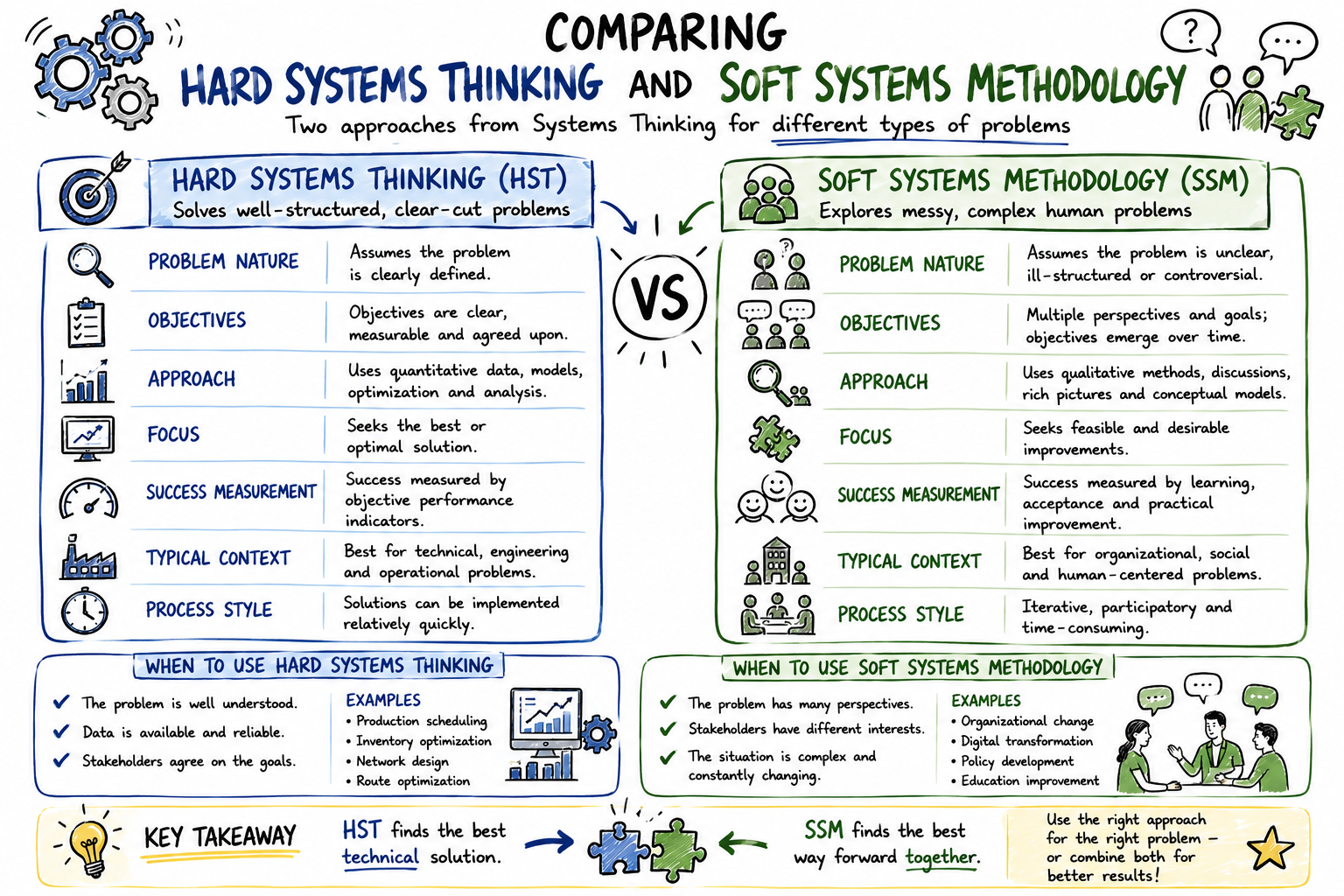
The two methodologies should not be viewed as competitors. Instead, they complement one another by addressing different types of organizational challenges.
When Should You Use Each Approach?
Choosing the appropriate methodology depends largely on the nature of the problem.
Hard Systems Thinking is appropriate when the objectives are clear, stakeholders agree on the desired outcome, and performance can be measured objectively.
Examples include:
- Optimizing transportation routes.
- Improving manufacturing efficiency.
- Scheduling production activities.
- Designing communication networks.
- Developing inventory management systems.
Soft Systems Methodology is more appropriate when the problem is ambiguous, stakeholders disagree on priorities, or organizational culture plays an important role.
Examples include:
- Digital transformation initiatives.
- Curriculum redesign in higher education.
- Improving employee engagement.
- Organizational restructuring.
- Community development projects.
- Healthcare service improvement.
Understanding the context of the problem is often more important than selecting the methodology itself.
Can Hard and Soft Systems Approaches Be Used Together?
Although Hard Systems Thinking and Soft Systems Methodology are often presented as separate approaches, many organizations successfully combine them.
A digital transformation project provides an excellent example.
At the beginning of the project, stakeholders may disagree about the organization’s challenges, priorities, and desired outcomes. In this situation, Soft Systems Methodology helps develop a shared understanding through stakeholder discussions, Rich Pictures, CATWOE analysis, and conceptual models.
Once stakeholders agree on the objectives, Hard Systems Thinking can be applied to design the technical solution, optimize system performance, allocate resources, and measure implementation success.
In other words, SSM helps answer “What problem are we trying to solve?”, while Hard Systems Thinking helps answer “What is the best technical solution?”
Using both approaches together often produces better results than relying exclusively on one methodology.
Looking Ahead
Soft Systems Methodology introduces several concepts that may be unfamiliar to readers, including Rich Pictures, Root Definitions, CATWOE analysis, and Conceptual Models. These tools form the foundation of the methodology and help organizations understand complex situations before deciding what improvements should be made.
In the next article, we will examine the Seven Stages of Soft Systems Methodology in detail. You will learn how each stage contributes to organizational learning and how the methodology can be applied to real world problems in education, business, and information systems.
Conclusion
Organizations face a wide variety of challenges, and no single methodology can solve every problem. Hard Systems Thinking excels when objectives are clear, measurable, and technical in nature. Soft Systems Methodology, on the other hand, is designed for situations where problems are complex, stakeholder perspectives differ, and human factors are central to understanding the issue.
Rather than viewing these methodologies as alternatives, organizations should recognize that they serve complementary purposes. Soft Systems Methodology helps build a shared understanding of complex situations, while Hard Systems Thinking provides structured techniques for designing and optimizing technical solutions.
Selecting the right approach, or combining both when appropriate, enables organizations to make better decisions, improve collaboration, and develop solutions that are both technically effective and organizationally sustainable.