
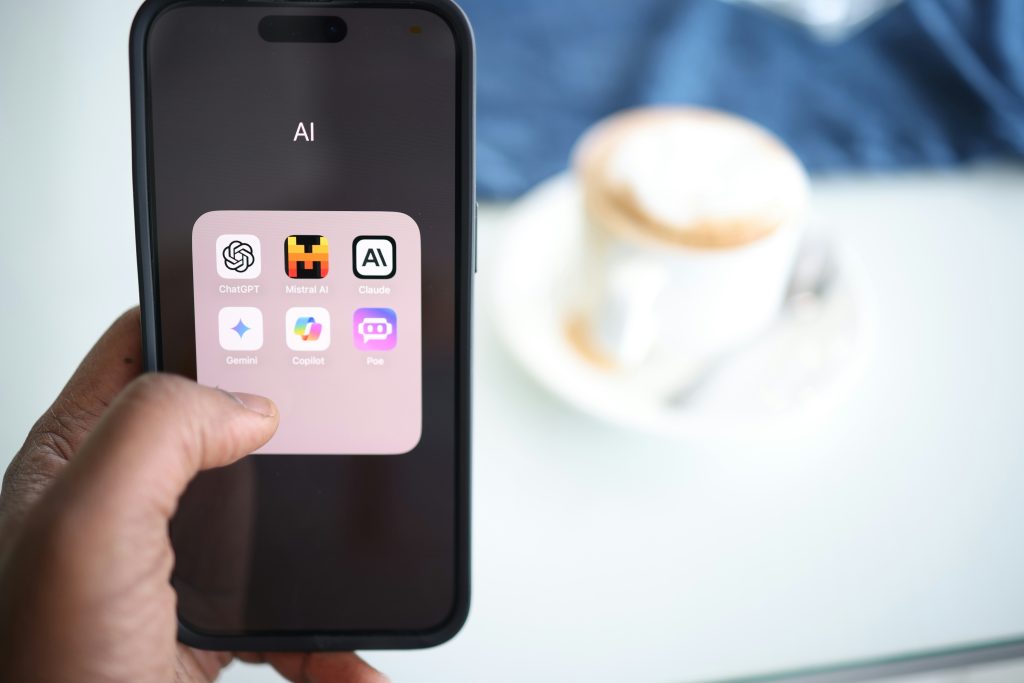
Artificial Intelligence, often called AI, is no longer a futuristic concept. It is already part of our daily lives, from the apps we use to the way businesses and governments make decisions. Understanding what AI is and how it connects to human intelligence is the first step to appreciating its power and limitations.
AI in Everyday Life
Think about the apps you use every day. TikTok shows you videos you might enjoy because its algorithms learn your preferences. Grab and Gojek suggest the fastest routes using AI prediction models. Netflix and Spotify recommend movies and songs that match your taste. Even tools like Google Translate and ChatGPT rely on natural language processing to communicate in human language.
AI has quietly become the invisible assistant that personalizes, predicts, and optimizes many aspects of life.
What is Intelligence?
Intelligence is more than memorizing facts. According to Gottfredson, it is the ability to reason, plan, solve problems, think abstractly, and learn from experience. Researchers often debate whether intelligence is about the knowledge you already have or the ability to learn new things. The general agreement is that both matter, but adaptability and learning ability are the most important.
Human Intelligence in History and Philosophy
The connection between intelligence and progress is not new. Ancient myths like Prometheus stealing fire highlight how knowledge transforms civilization. Philosophers such as Plato, Descartes, and Kant debated whether intelligence comes from the soul, the mind, or innate ideas. Today, psychology combines both nature and nurture, suggesting that intelligence is shaped by genetics, environment, and education.
Cognitive Science and Neuroscience
Cognitive science compares the brain to a computer system: input, processing, and output. Intelligence is not just about storing facts but solving new problems with creativity and reasoning. Neuroscience adds another layer by showing how billions of neurons in the brain enable memory and learning. These biological insights inspired the creation of Artificial Neural Networks, which form the backbone of modern AI.
A Short History of AI
AI has gone through cycles of excitement and disappointment.
- Pre-AI (1943–1950): Early experiments with logic and computing.
- First Golden Age (1956–1974): Optimism and the creation of the first AI programs.
- AI Winter (1974–1980s): Funding cuts and slow progress.
- Second Golden Age (1980–1987): Expert systems in medicine and business.
- Second Winter (1987–1993): High costs and unmet promises.
- Third Golden Age (1994–Now): Big data, deep learning, and breakthroughs like AlphaGo and ChatGPT.
This history shows that AI advances when data, computing power, and practical needs come together.
The Turing Test
In 1950, Alan Turing proposed a simple question: if you cannot tell whether you are speaking with a machine or a human, should the machine be considered intelligent? While some AI tools today can fool people in short conversations, many still fail in deeper reasoning. The test raises the question: is mimicking humans the same as true intelligence?
Strong AI vs Weak AI
AI can be divided into two categories.
- Strong AI (General): Machines that think and reason like humans. This does not exist yet.
- Weak AI (Narrow): Systems built for specific tasks. This is the AI we use today, from recommendations to chatbots.
ChatGPT, for example, can generate human-like answers but does not actually understand. That is why it is considered a form of weak AI.
Five Core Components of AI
Modern AI systems rely on five main components:
- Machine Learning – algorithms that learn from data, like Spotify or TikTok recommendations.
- Data Mining – discovering patterns in data, such as Amazon product suggestions.
- Computer Vision – allowing machines to see and interpret images, like Face ID or Google Lens.
- Natural Language Processing (NLP) – enabling machines to understand and generate human language, used in Google Translate and ChatGPT.
- Ontological Search – improving how search engines understand meaning, as seen in Google’s semantic search.
AI is inspired by human intelligence but remains far from human-level reasoning. It has already become part of everyday life through weak AI systems, while strong AI remains a future goal. The key to understanding AI is not just in its history or technical details but in recognizing how it connects with the way humans think, learn, and adapt.
The journey of AI is still unfolding, and the next breakthroughs may be closer than we think.