
In many classrooms, the same pattern repeats itself. The lecturer asks a question, a few confident students respond, and the rest remain silent. While this may create the impression of an active discussion, it often leaves many students as passive observers rather than active participants.
One teaching strategy that helps overcome this challenge is the Chain Note technique. It is simple to implement, requires minimal preparation, and encourages every student to contribute to the learning process.
What Is Chain Note?
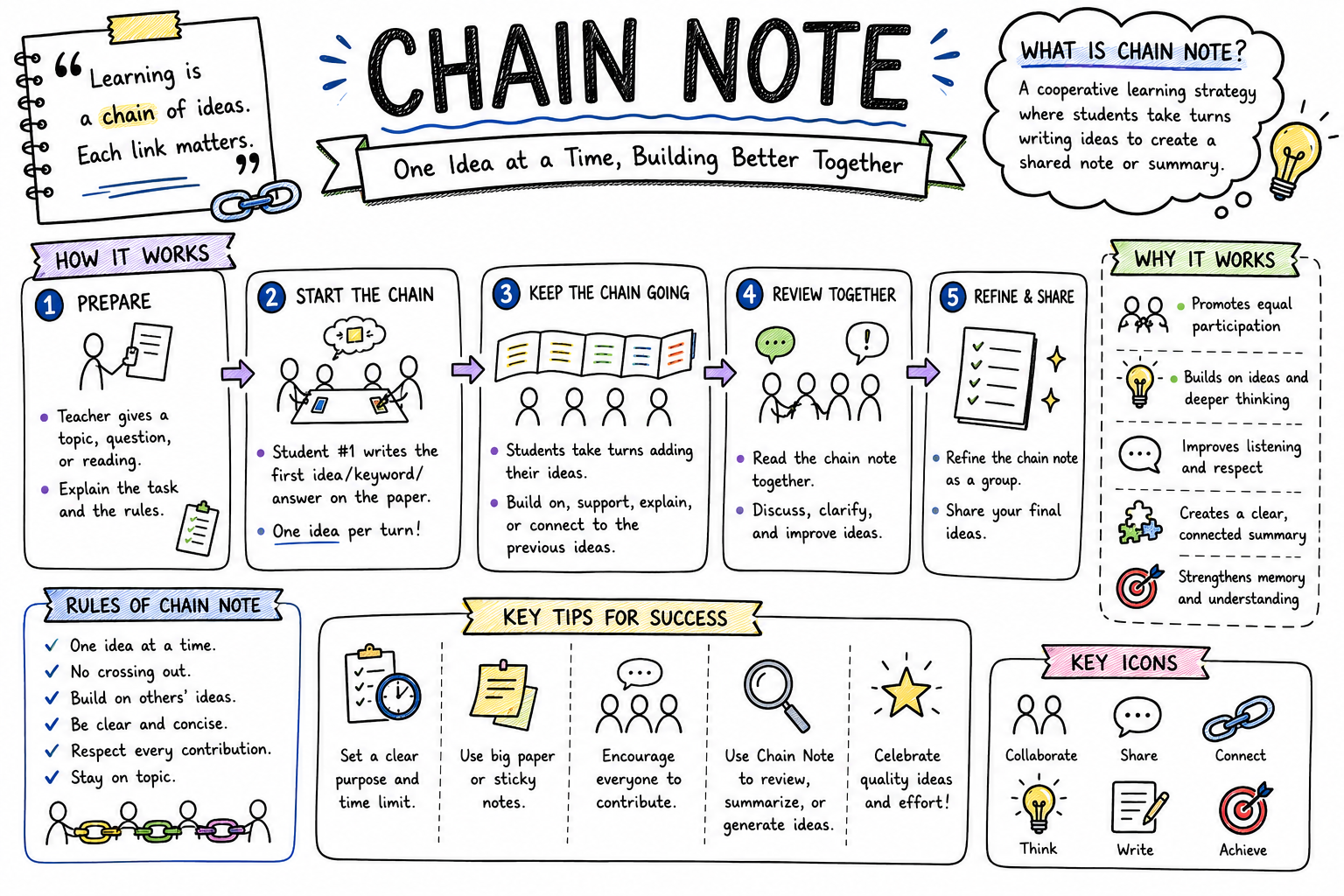
Chain Note is a collaborative learning activity where students build knowledge by contributing ideas one after another. Instead of responding only to the lecturer, students respond to the work of their classmates, creating a continuous chain of thinking.
Each student adds a short response, idea, question, example, or solution before passing the note to another student. By the end of the activity, every participant has contributed, resulting in a collective record of the group’s thinking.
Unlike a traditional discussion, where only a few voices dominate, Chain Note ensures that participation is distributed more evenly across the class.
Why Use Chain Note?
Chain Note supports several important learning principles.
First, it promotes active learning. Students are not simply listening. They are required to process information, formulate ideas, and communicate them clearly.
Second, it encourages retrieval practice. Rather than rereading notes, students recall what they have learned and apply it in writing, strengthening long term retention.
Third, it provides opportunities for peer learning. Students read the contributions of others, compare perspectives, and refine their own understanding.
Finally, it creates a low pressure environment for participation. Students who may feel uncomfortable speaking in front of the class often find it easier to express their ideas in writing.
How Does Chain Note Work?
A typical Chain Note activity follows these steps.
Step 1: Prepare a Prompt
Begin with an open ended question that encourages thinking rather than memorization.
Examples include:
- What are the advantages of cloud computing for small businesses?
- Identify one usability issue in this mobile application.
- Suggest one strategy to improve cybersecurity awareness in organizations.
- Explain one factor that contributes to successful digital transformation.
Step 2: Students Write Their Response
Each student writes a brief answer. Depending on the activity, responses may consist of one sentence, a short paragraph, a diagram, or a list of key points.
Step 3: Pass the Note
Students pass their paper to the next person in the group.
Step 4: Build on Previous Responses
The next student reads the existing contribution and adds something meaningful. They might:
- expand an idea,
- provide an example,
- ask a clarifying question,
- respectfully challenge an assumption, or
- connect the idea to another concept.
This process continues until everyone has contributed.
Step 5: Reflection
After the notes return to their original owners, students review the complete chain and discuss the different perspectives that emerged.
The lecturer may then facilitate a whole class discussion based on common themes, misconceptions, or particularly insightful responses
Example in a Digital Business Class
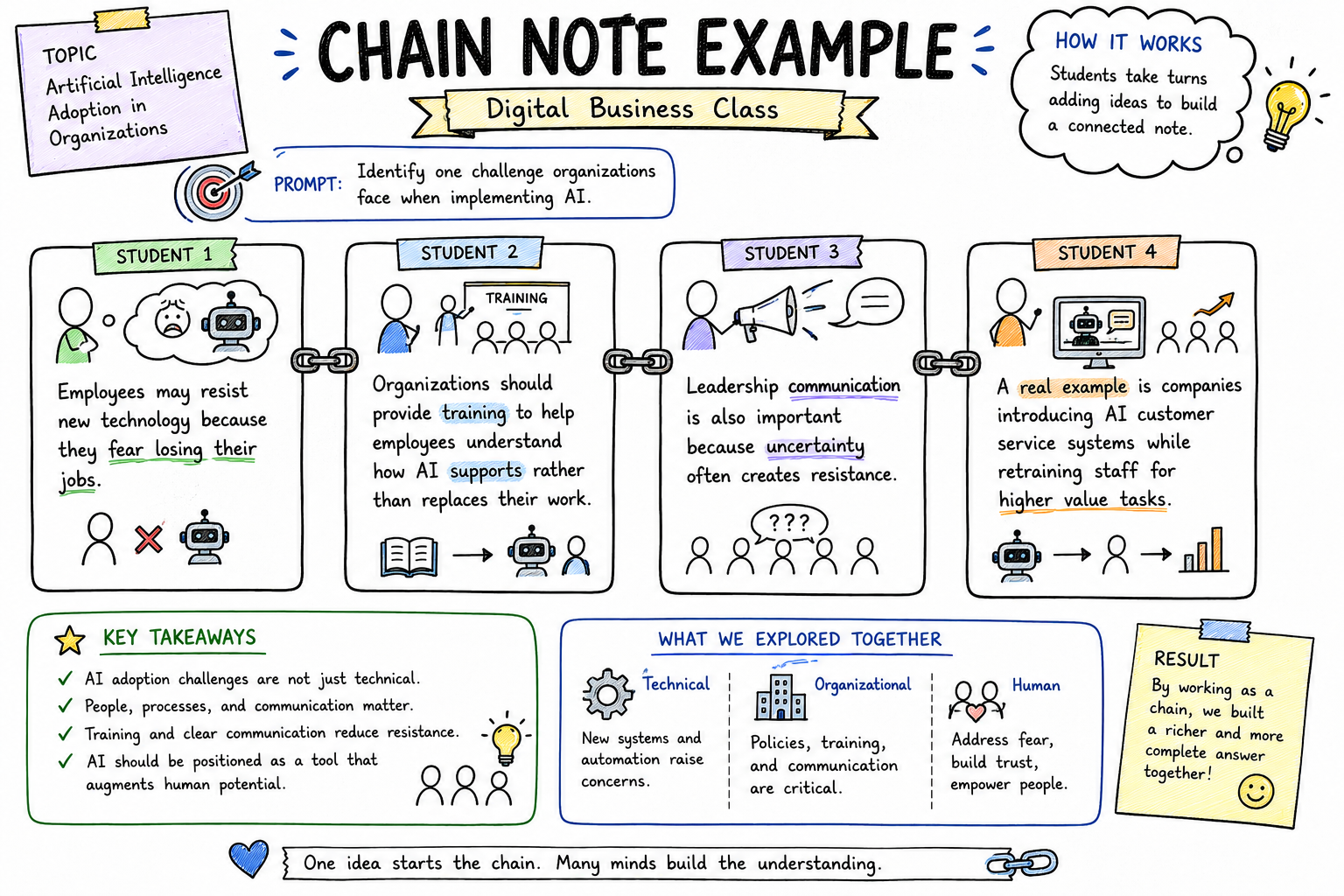
Imagine students are learning about artificial intelligence adoption in organizations.
The prompt could be:
“Identify one challenge organizations face when implementing AI.”
The chain might develop like this:
Student 1:
Employees may resist new technology because they fear losing their jobs.
Student 2:
Organizations should provide training to help employees understand how AI supports rather than replaces their work.
Student 3:
Leadership communication is also important because uncertainty often creates resistance.
Student 4:
A real example is companies introducing AI customer service systems while retraining staff for higher value tasks.
By the end of the activity, students have collectively explored technical, organizational, and human perspectives.
Variations of Chain Note
The flexibility of Chain Note makes it suitable for many learning contexts.
Brainstorming
Students generate as many ideas as possible before evaluating them.
Case Analysis
Each student contributes one recommendation for solving a real world problem.
Peer Feedback
Students review project proposals and add constructive suggestions.
Reflection
Students summarize what they learned after a lecture or practical session.
Problem Solving
Each contribution represents the next logical step toward solving a complex problem.
Online Implementation
Chain Note is not limited to face to face classrooms.
The same approach can be implemented using digital tools such as:
- Google Docs
- Microsoft OneNote
- Microsoft Loop
- Padlet
- Miro
- Moodle discussion forums
- Canvas Discussions
Students contribute sequentially while preserving the collaborative nature of the activity.
Advantages
Chain Note offers several benefits.
- Every student participates.
- Encourages critical and reflective thinking.
- Builds collaborative learning skills.
- Reduces anxiety for quieter students.
- Creates visible evidence of learning.
- Requires little technology or preparation.
- Can be completed in as little as 10 to 20 minutes.
Challenges
Like any instructional strategy, Chain Note also has limitations.
Some students may simply repeat previous ideas instead of extending them. Clear instructions and examples help prevent this.
Time management is also important. Setting a fixed writing time for each round keeps the activity moving.
Finally, lecturers should monitor discussions to ensure that contributions remain constructive and relevant to the learning objectives.
Tips for Success
To maximize learning, consider the following recommendations:
- Use open ended questions that encourage analysis rather than recall.
- Limit each contribution to one key idea.
- Encourage students to extend rather than repeat previous responses.
- Rotate group membership throughout the semester.
- End the activity with a class discussion or reflection.
- Connect the activity directly to the course learning outcomes.
Final Thoughts
Chain Note demonstrates that active learning does not always require sophisticated technology or elaborate classroom activities. Sometimes, meaningful learning happens when students simply build on each other’s thinking.
By ensuring that every learner contributes, Chain Note transforms passive note taking into collaborative knowledge construction. It develops communication, critical thinking, reflection, and teamwork while giving lecturers valuable insight into students’ understanding.
Whether you teach Computer Science, Digital Business, Engineering, or any other discipline, Chain Note is a practical strategy worth adding to your teaching toolkit. Its simplicity is one of its greatest strengths, making it an effective way to increase engagement and foster deeper learning in almost any classroom.