

Every educator knows the exhaustion of the “delivery trap”—that classroom dynamic where the teacher does 100% of the talking, and students do 100% of the passive staring. If you are looking to flip that script and transform your classroom into a buzzing hub of student-led discussion, there is no better strategy to deploy than the Jigsaw method.
Originally engineered by psychologist Elliot Aronson in 1971 to promote collaboration in newly desegregated schools, the Jigsaw strategy has become a cornerstone of cooperative learning.
But as the method evolved, a major update emerged: Jigsaw II.
In this installment of The Pedagogy Playbook, we are going to break down how both Jigsaw I and Jigsaw II work, analyze their crucial differences, and help you decide which blueprint to deploy in your next lesson on hellomrdon.com.
The Core Blueprint: Anatomy of a Jigsaw
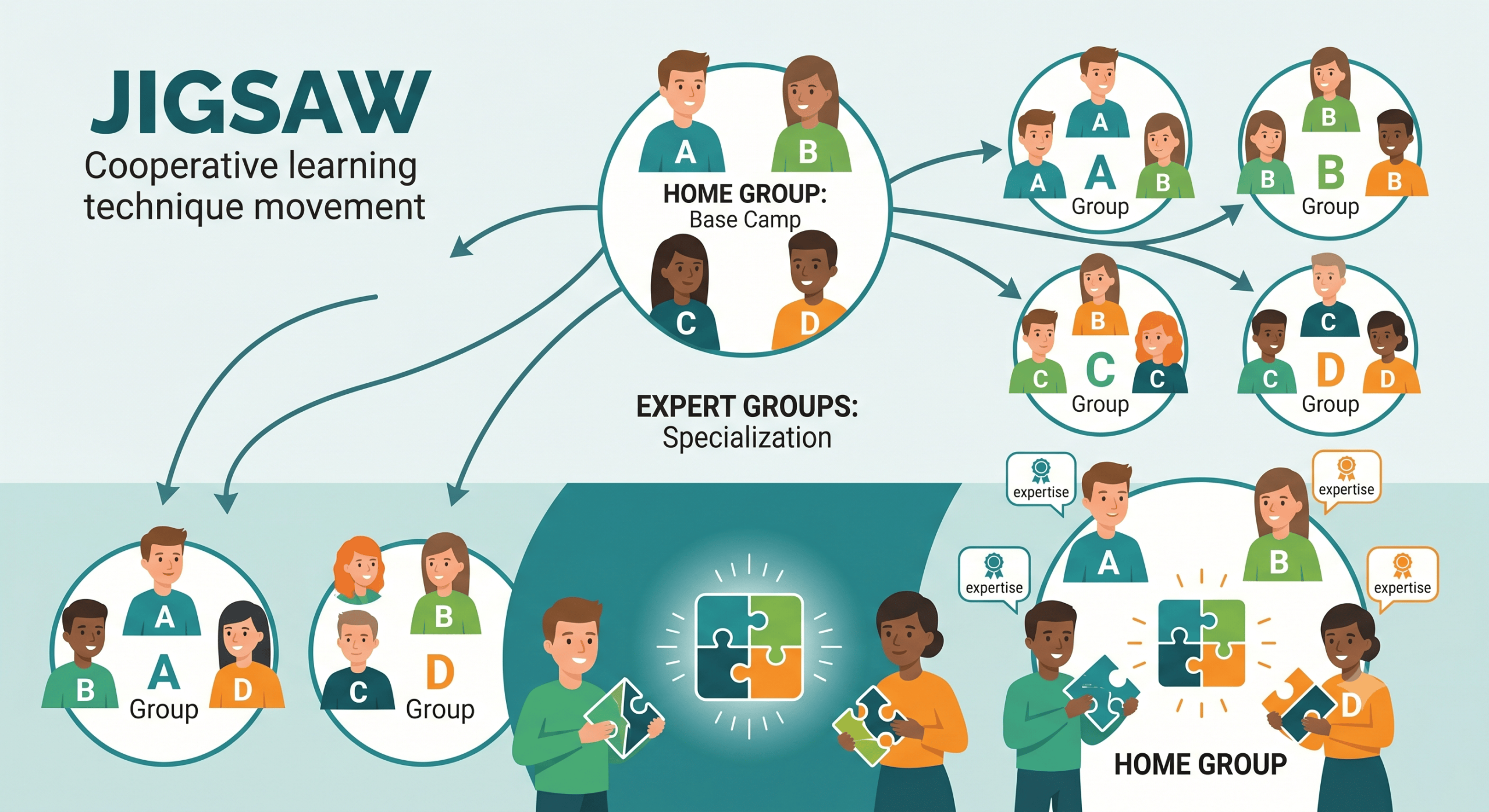
Before diving into the variations, let’s look at the foundational mechanics. In any Jigsaw activity, students navigate two distinct groupings:
- The Home Group: A diverse base camp of 3–5 students. The day’s lesson is split into separate segments, and each member of the Home Group is assigned a specific segment to master.
- The Expert Group: Students from across the classroom who were assigned the same segment gather to read, analyze, and become “experts” on that specific topic.
Once the experts have conquered their material, they return to their Home Group to teach their teammates. No single student can understand the full picture without the contributions of every peer.
Jigsaw I: The Aronson Model (Pure Interdependence)
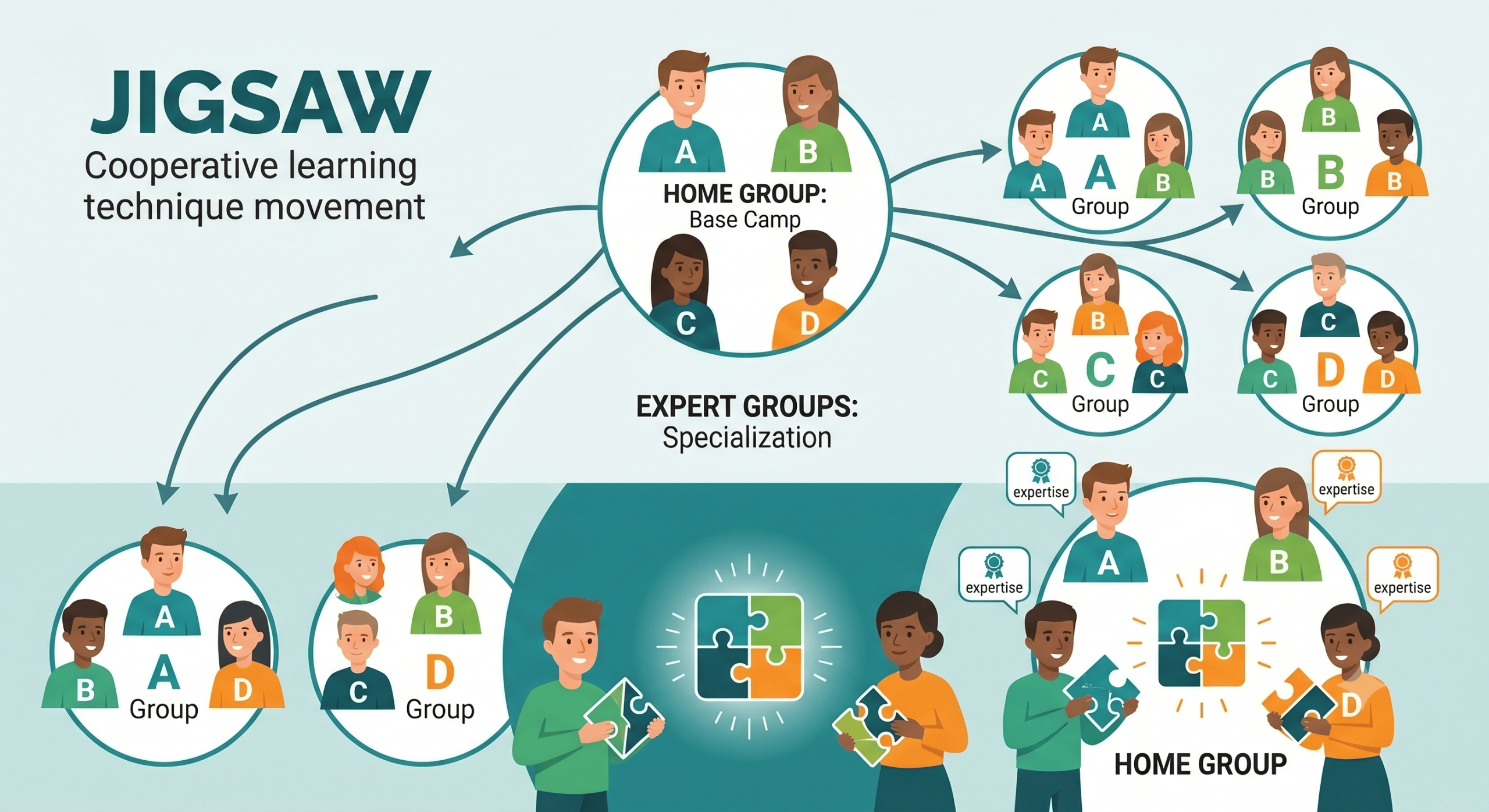
The original 1971 model relies on a strict, fragmented division of labor.
- The Setup: The learning material is physically chopped into completely separate pieces.
- The Process: If your class is studying the Water Cycle, Student A reads only about Evaporation, Student B reads only about Condensation, and Student C reads only about Precipitation.
- The Catch: Students do not have access to the other texts.
The Journalistic Take: Jigsaw I is a radical exercise in equity and social engineering. Because Student A holds a complete monopoly on the information regarding Evaporation, the group must listen to them. It forces engagement from quieter students and humbles dominant students, because everyone is utterly dependent on each other to pass the final assessment.
Jigsaw II: The Slavin Adaptation (The Pragmatic Update)
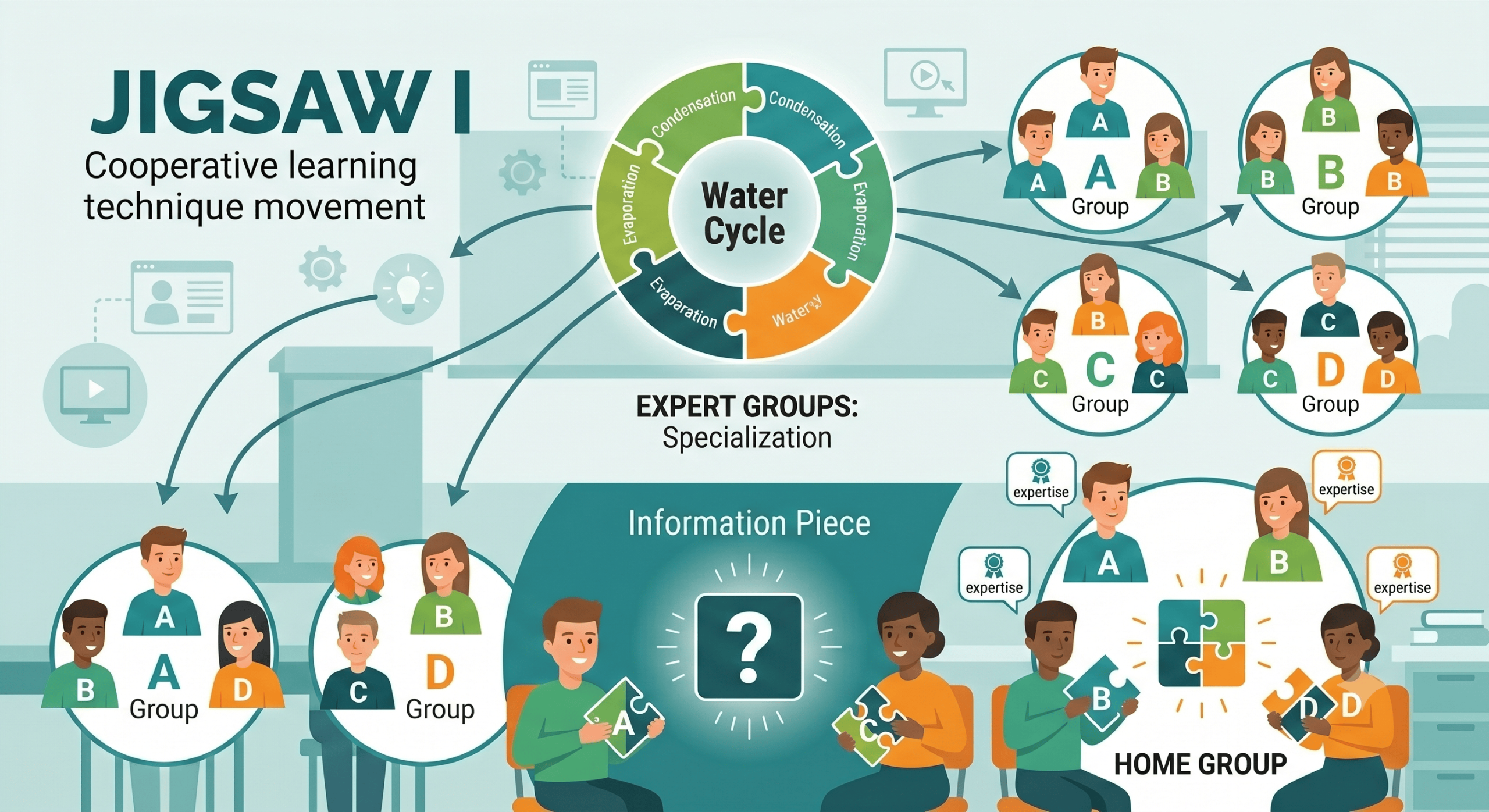
In 1978, educational psychologist Robert Slavin modified the original framework to address a practical classroom vulnerability: What happens if a student is absent, unmotivated, or deeply struggles with reading comprehension? In Jigsaw I, their entire Home Group suffers.
Slavin’s Jigsaw II solves this with a few clever tweaks:
- The Setup: All students read the entire assignment or text. * The Process: While everyone reads the same master text, each student is given a specific “Expert Lens” or topic to focus on. For example, everyone reads a chapter on the Water Cycle, but Student A focuses on the role of heat, Student B focuses on atmospheric changes, and Student C focuses on geographic impacts.
- The Big Shift (Accountability): Jigsaw II introduces a team-reward system based on Slavin’s Student Teams-Achievement Divisions (STAD). Students take individual quizzes, but their scores are averaged into a Team Improvement Score. Teams are rewarded based on how much each student improved compared to their past performance.
Head-to-Head: Jigsaw I vs. Jigsaw II
To help you choose the right play for your next lesson, let’s look at how they stack up side-by-side:
| Feature | Jigsaw I (Aronson) | Jigsaw II (Slavin) |
| Reading Material | Fragmented. Students only read their specific part. | Comprehensive. All students read the entire text. |
| Peer Dependence | Extreme. You literally lack the text to learn other parts on your own. | Moderate. You have the text, but need peers for synthesis and deep analysis. |
| Classroom Resilience | Vulnerable if a student is absent or fails to comprehend their piece. | High. If a peer struggles, teammates still have the foundational text to lean on. |
| Motivation System | Driven by social responsibility to the group. | Driven by individual accountability and Team Improvement Scores. |
The Playbook Verdict: Which One Should You Use?
Use Jigsaw I if:
Your primary goal is social cohesion, equity, and soft-skill development. If you have a classroom with high social friction, cliques, or students who consistently hide in the background, Jigsaw I forces them to communicate and value one another’s presence.
Use Jigsaw II if:
Your primary goal is rigorous academic mastery of complex content. Because every student reads the whole text, no one misses out on big-picture context. The inclusion of the Team Improvement Score also adds a gamified element of friendly competition that can hyper-charge student engagement.